
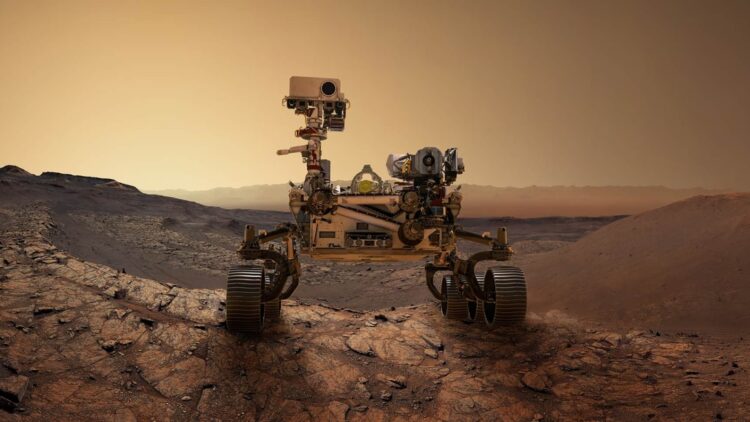
Did you know that Mars, the “Red Planet,” may have once looked a lot like Earth? Thanks to NASA’s Perseverance rover, scientists confirmed that a huge ancient lake once existed inside Jezero Crater on Mars. This discovery is super exciting because lakes are places where life can exist. So, if there was ever microbial life on the Red Planet, this is one of the best places to look for clues. Let’s find out more about this discovery.
What was Jezero Crater?
Jezero Crater was once a huge basin on Mars, measuring about 45 kilometers (28 miles) across. Billions of years ago, rivers poured into this basin, filling it with water and forming a large lake. Along with the water came sand, mud, and small rocks that settled at the bottom. Over time, these materials stacked up in layers, like chapters in a history book, preserving the story of Mars’ ancient past.
When the Perseverance rover landed on February 18, 2021, its mission was to explore these layers and search for clues of past life.
How did Perseverance look underground?
Perseverance carried a special tool called RIMFAX (Radar Imager for Mars’ Subsurface Experiment). It worked a bit like X-ray vision. As the rover drove across the crater, RIMFAX sent radar waves into the ground every 10 centimeters. These waves bounced back and created an underground map up to 20 meters (65 feet) deep.
Thanks to this, scientists from UCLA and the University of Oslo were able to see what was hidden below the surface of Mars.
What did the rover discover?
The radar results showed that Jezero Crater really did hold a lake a long time ago. Scientists identified two main stages of water activity:
- First stage: The crater filled with water, and sediments slowly built up in flat, horizontal layers.
- Second stage: Later, the water levels changed, forming a huge river delta—similar to the Mississippi River delta on Earth.
These discoveries confirmed that Jezero was not just a temporary puddle. It was a long-lasting lake, making it one of the most promising places to look for signs of life on the Red Planet.
Could life have existed in Mars?
On Earth, lakes are full of life. Even if Mars never had fish or plants, it could have had microbes, small organisms invisible to the eye. If microbes once lived in Jezero’s waters, their remains could still be trapped in the sediments.
That is why Perseverance collected dozens of rock and soil samples. In the future, another mission is expected to bring those samples back to Earth so scientists can check if they contain traces of ancient Martian life.
Why was this important?
The discovery showed that Mars was once very different from the cold, dry desert we see today. Long ago, it had rivers, lakes, and liquid water, just like Earth.
By studying Mars, scientists hoped to answer some of the biggest questions ever asked: Did life exist outside Earth? How did Mars lose its water? Could humans survive on Mars one day?
The findings from Jezero Crater helped researchers understand how the Martian environment changed over time.
So, Mars had a watery past
The Perseverance rover proved that Jezero Crater was once a lake. This discovery gave scientists one of the best chances yet to find out if life ever existed on the Red Planet. Even if no life is discovered, the samples Perseverance collected will still reveal how planets like Mars evolved and why Earth turned out so unique.
So, when you look up at the night sky and spot the red glow of Mars, remember: billions of years ago, it may have been home to a giant lake, and maybe even tiny living creatures. Isn’t the universe so fascinating?