
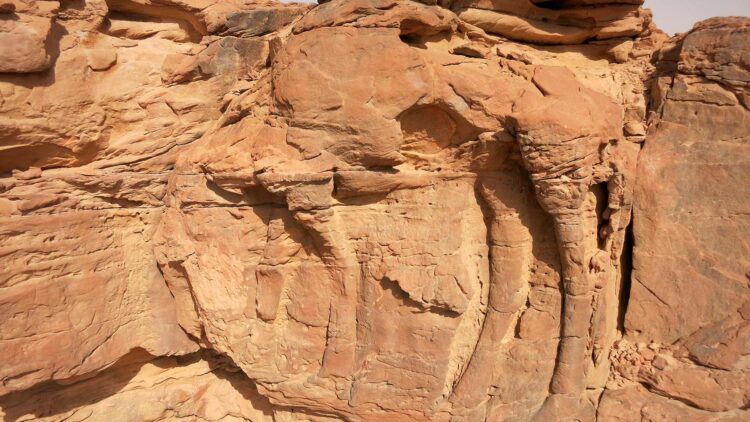
Saudi Arabia is more than just desert, dunes and an arid landscape, and this country holds one of the best kept secrets of human prehistory, they have found camel sculptures that were carved more than 7,000 years ago, which makes it one of the oldest treasures in history! (even older than Stonehenge and the Pyramids)
What are we talking about?
A sculpture of camels, located in the Al-Jawf region, called the Camel Site, we are talking about the oldest animal relief art known! They were there long before anyone even dreamed of building a pyramid…
The Neolithic landscape
It is hard to imagine, but eight thousand years ago Arabia was not a desert. The climate was milder, with savannas, lakes and much more animal life. Humans lived from hunting, gathering, and were just beginning to domesticate animals.
That is why the camels that appear in the sculptures were not domesticated, but wild. The details on their bodies suggest they had some kind of ritual meaning. Maybe related to fertility or natural cycles. What does seem clear is that this place was not just a workshop, but a meeting point for the nomadic communities of the area!
A work without modern tools
One of the most impressive things is that each camel is carved life-size, in three dimensions, coming directly out of the rock. No flat drawings, they are perfect. To do that they needed entire days, stone tools like flint, and probably improvised scaffolding to reach the upper parts, how they managed it is and will remain a mystery. And not only that: some of the sculptures were retouched several times over generations, which indicates that the site remained active for centuries as a symbolic place, something like a sacred site!
Art before History
There is nothing like it, not in Egypt, not in Mesopotamia, not in any other civilization of that time. That is why archaeologists are considering the role of Arabia in world prehistoric history.
And of course, it has also reopened questions about the famous mustatil, which were stone structures that appeared in the same region, although their function is still unclear, many believe they could be related to these camel sculptures. But that is a mystery!
In danger
And although it is not the best news, we must remember that this heritage is in danger, why? Because of erosion, and the neglect that this area is suffering, there are even agricultural machines that have already damaged some parts of the sculpture and several pieces of the rock have fallen off. Doesn’t this planet know how to preserve the historical heritage we have? We are talking about the memory of an era that is not yet in the history books, about which we know almost nothing, but that for some reason, someone wanted to leave engraved in stone forever.
The Camel Site is a window to the past, proof that even before the first civilizations we know, the drive for art already ran through our veins! We wanted to represent the world as we saw it, and that is what these people did in stone, and even if it is hidden among dunes and aridity, it is our history and it is there, waiting for us to understand it!