
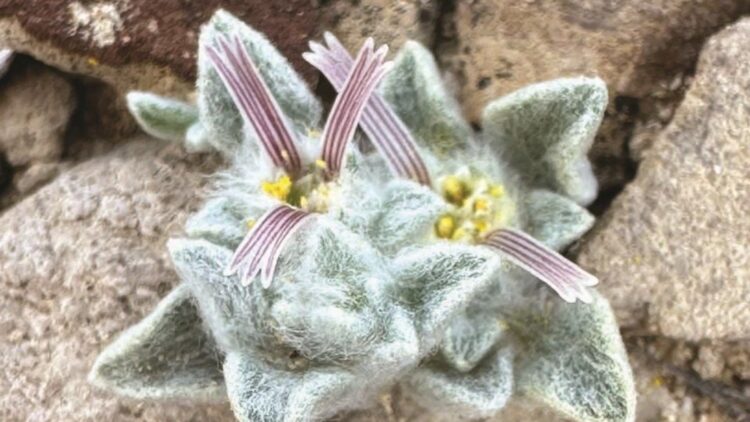
What’s the first thing that comes to your mind when you hear ‘Texas’? Most people would say cowboys, barbecues, country music or American football matches. However, Texas isn’t just popular for its culture and traditions, because this state hides secrets in its desert landscapes. The most recent finding confirms this: a new way of life called Woolly Devil, which was found in the Big Bend National Park in the Chihuahua desert.
If this is not important enough, you should also know that this is the first time such a rare plant has been found in a national park in the United States since 1976. So, let’s learn more about this incredible finding, shall we?
Big Bend
The Big Bend National Park is known for its boiling temperature and its difficult conditions for any type of life. Until now, its presence in this zone just offered spectacular landscapes and adventures for explorers, but it wasn’t such a big deal for the scientific community.
But this changed when a volunteer called Deb Manley encountered a strange plant. At that moment, nobody knew nothing about this plant, but she was in front of the Woolly Devil, a new member in the botanic field that has increased scientists’ curiosity around the world.
What’s the Woolly Devil
It is a tiny plant, measuring less than 8 centimeters of diameter. At first glimpse, it could be unnoticeable, but it has unique features:
- White hairs that cover its surface, giving it a wool-like appearance.
- Two maroon-colored florets that look like tiny horns, inspiring the nickname “Woolly Devil.”
- A very poor ability to reproduce, which makes it rare and fragile.
Having all these features in mind, scientists had to create a new genus to classify it called Ovicula biradiata.
Similar case to the one in 1976
Maybe most people aren’t totally aware of the importance of this Texas finding, that is why we are going to go back a bit in time. The last time that something like this happened was in 1976, when another rare plant called Dedeckera eurekensis (known as July Gold) was found in Death Valley in California. That plant was difficult to reproduce and it shocked the scientific community.
Now, almost 50 years later, the Woolly Devil has become the first big discovery of this kind in a national park in the U.S.
Importance of this Texas discovery
Beyond the curious it is to see a plant like the Wooly Devil, this discovery has several implications:
- It proves life can adapt to extreme conditions. The Texas desert seems inhospitable, yet this little plant found a way to survive there.
- It shows we still don’t know everything about our planet. Even in well-studied areas like Big Bend, nature can surprise us.
- It highlights the importance of protecting national parks. If rare species like this exist in preserved landscapes, it’s a sign of how valuable conservation really is.
What about the future?
The Wooly Devil opens the door to keep exploring and caring about Texas nature and all around the world. Scientists believe that, if it was possible to find this plant after decades of research, maybe there are other species in deserts, mountains or forests worldwide.
What’s more, this Texas discovery is a reminder that science happens in big labs and with space telescopes, but also happens thanks to the patience of volunteers and explorers who love nature.
So, next time you are asked about Texas you can say more than cowboys, or barbecues, the Woolly Devil will be your hidden data to surprise everybody. What do you think about this plant found in Texas?