
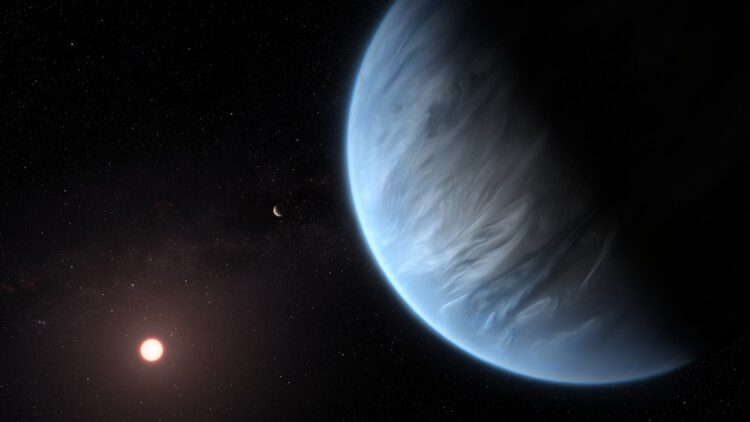
Is there life beyond Earth? Well, we still cannot answer this question with certainty, but we can tell you that they have detected something that could change everything. For the first time, scientists believe they have detected something that could give us a lot of information about the formation of universes. We are talking about the exoplanet K2-18b, 124 light years away (a bit far) yes, but they have found molecules that on our planet are only generated by living organisms. Do you get it now?
A new trendy planet
K2-18b is a planet that orbits a red dwarf star in what they call the “habitable zone,” or in other words: a region where, in theory, there could be liquid water. You know what it means for water to exist on a planet, right? Water is synonymous with life, just as it happened here on our planet.
A team from the University of Cambridge has used the James Webb Space Telescope to analyze the atmosphere of this planet, and what they detected there is dimethyl sulfide (DMS) and dimethyl disulfide (DMDS). Those compounds, on Earth, are produced by phytoplankton and certain bacteria. And on K2-18b, if the data is correct, they would be present in quantities thousands of times greater than ours. Could there be an active biosphere there? That is the big question.
A planet with many possibilities
The curious thing is not only the presence of these “biological” molecules. It is also what has not been detected: ammonia. According to the researchers, it could indicate that there are oceans capable of absorbing it, just as it happens on Earth. Some are already talking about an ocean world with some similarity to our planet in its early stages. Others prefer to raise colder hypotheses: that it could be a mini-Neptune without a solid surface or a world with oceans of molten rock, but not the discovery of the century.
And how reliable is the data?
For now, the certainty of this finding is at 99.7%. That in science is known as “three sigma.” For something to be officially confirmed, a 99.99999% reliability (five sigma) is required. That is, victory cannot be declared yet. But it is a very promising beginning and we want to know already what is happening out there.
Catherine Heymans, Royal Astronomer of Scotland, has reminded that we still do not know if certain geological processes could produce similar compounds. So, although many are excited, we also have to be aware and remain cautious.
What is behind all this
The person responsible for the study, Professor Nikku Madhusudhan, believes that this finding could be a “turning point” in the search for life beyond the solar system. And it is no wonder. If it is eventually confirmed that those molecules have a biological origin, K2-18b could become the first planet with proven life beyond Earth, even if it is not humanoid life.
The James Webb Telescope, for its part, once again makes it clear that it has opened a new era in astrobiology. The precision with which it can analyze exoplanet atmospheres is unprecedented, and it is allowing exploration of regions of space that until very recently were pure speculation, it is something incredible!
And now what?
K2-18b has earned, on its own merits, the title of the most promising exoplanet in the search for life. It has an atmosphere, it is in a zone with temperatures compatible with liquid water and it could have oceans. That is already much more than has been had with any other candidate to date.
The coming years are going to be key. If new observations confirm what James Webb seems to be pointing to, we could be facing one of the most important discoveries in