
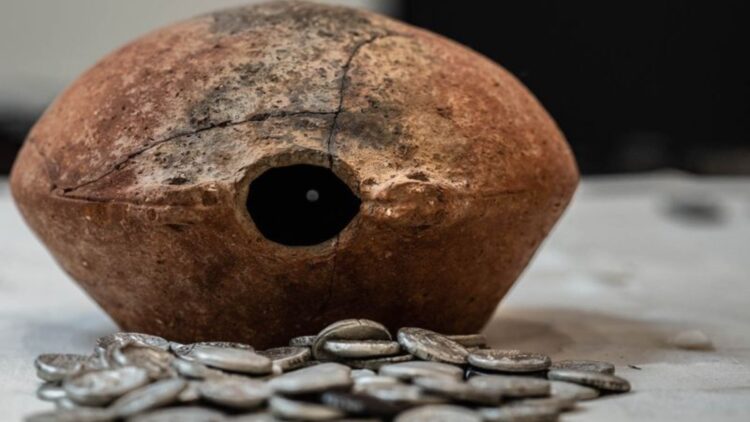
How important can a vase discovery be? Well, let me tell you that every excavation work is the scenario where many ancient objects are found, and this one happened in the heart of the Sharjah desert in the United Arab Emirates. Archaeologists found what seemed like a simple vase, but it was actually filled with 409 silver coins more than 2,300 years old. This finding shows that Arabia wasn’t an isolated place, but instead it played a key role in global trade during antiquity. So, let’s find out more about this discovery, shall we?
The vase hiding a treasure
When archaeologists found a clay vase in 2021, they noticed something strange: it weighed more than 9 kg. So, they decided to open it and that’s when they saw no grains nor water inside, but a treasure: hundreds of silver coins carefully preserved.
These coins date back to the 3rd century BC, more than 2 millennia, and they show the strong influence from Alexander the Great’s legacy and the Hellenistic world.
The coins inside the vase
Most of the coins are tetradrachmas, a common concept in the Hellenistic time. Each one weighs between 16 and 17 grams and carries very fascinating images.
In the most ancient coins appear Alexander the Great representations as Hercules and the Greek God Zeus on his throne. With the passage of time, these images were replaced by Aramaic inscriptions and local motifs.
This shows a cultural mix: cultures in Arabia were blending Greek styles with local traditions, creating a unique cultural identity. In this sense, the vase is more than just a container of wealth—it is a snapshot of global exchange and cultural fusion.
Mleiha: a strategic city
The finding of the vase in Mleiha confirms that this city was more than an agricultural settlement. Located between the Persian Gulf and the Gulf of Oman, it was a key point for trade routes connecting India with the Mediterranean.
Arab merchants traded spices, incense, textiles, and precious metals; and they needed coins recognized internationally. That’s why the coins in the vase proved how Mleiha produced money inspired by the Greeks, but adapted to their own commerce.
Unexpected larger trade network
The vase is not an isolated discovery, similar coins have been found in other places of the Gulf, like Bahréin or Kuwait. This means there was already a regional monetary network that used Greek symbols, but with local variations.
This detail makes the discovery more important since it proves that Arabia was integrated into a global trade system far more complex than it was thought.
A place with deep roots
Even though the coins in the vase date back to the 3rd century BC, Mleiha’s history stretches back much further. Excavations in the area show human occupation since 130,000 years ago.
In recent times, the city thrived thanks to agriculture and to advanced underground irrigation systems called falaj, which made farming possible in the desert. With the passage of time, Mñeiha became a fortified city with palaces, temples, and workshops, which explain why such a valuable treasure was hidden there.
The vase rewrites the past
This discovery has an incalculable value. Until now, it was thought the Hellenistic influence was limited to the Mediterranean, Mesopotamia, and northern India. However, this vase shows that the Arabian Peninsula was also deeply involved in that global network.
What’s more, the evolution of the coins in the vase (from Greek symbols to regional transcriptions) show that Arabia didn’t copy foreign cultures, but it actively reinterpreted and reshaped foreign influences using them as tools of power and prestige.
So, now you know more about the importance of the things archaeologists find in excavations, isn’t it fascinating how simple objects from the past let us learn more about other times?