
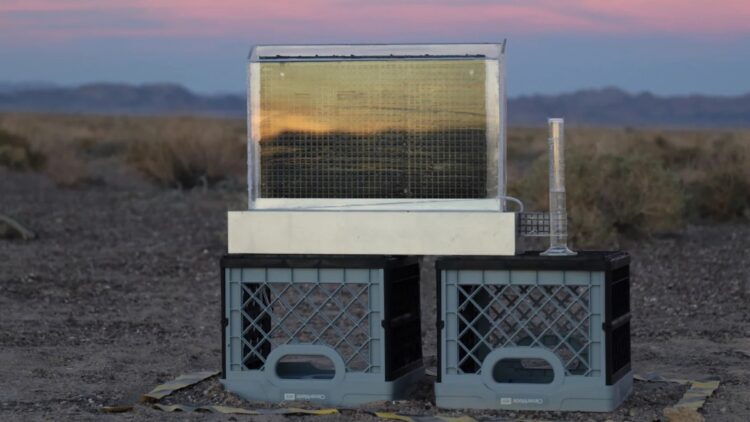
MIT (Massachusetts Institute of Technology) has left everyone speechless with its new device, and they chose the driest and most extreme place on the planet to test it, the Death Valley desert.
It is a panel the size of a window, made with hydrogels that capture moisture from the air and transform it into drinking water. All without electricity, only with the heat of the sun. How?!!!
MIT creation
At first glance it looks like just a black wrapper full of bubbles, but inside it hides “a secret”. During the nights, it absorbs water vapor and any moisture present, and with the heat of the day it swells, releases the water and it condenses on a glass, then falling through a tube into a small tank, just like opening a natural tap.
For now it only manages to produce two thirds of a cup a day, but if research continues, who knows if one day soon it could supply homes in the most arid climates on the planet?
Air as a source of water
If we look at our planet, around 2 billion people do not have safe access to drinking water, and climate change worsens the situation by causing longer and longer droughts… The atmosphere, however, is an immense reserve of moisture and it is still a little-explored area.
For centuries, cultures all over the world collected water from dew or fog, but the problem with modern techniques is that they usually require a lot of energy and high levels of humidity, so this made it impossible to use in deserts.
But the key to this is that it uses hydrogels that are capable of absorbing up to 10 times their own volume! Even in the driest possible conditions…
How the device works
- The hydrogels are cheap polymers, the same ones used in diapers, that capture moisture without fans or cooling systems, so they “do not consume”.
- At night they store vapor and with the sun of the day they release it. The water condenses on the glass and is collected in a tank.
- Solar energy: the entire process is carried out without external electricity, only with natural heat, and in the desert there is plenty of that!
Does it have limitations?
Of course, it has already been tested in places like the Atacama desert (Chile) and Las Vegas, with good results. But the challenges are still big:
- Current production is very low and does not result in much water
- The cost per liter is much higher than tap water or even desalination…
- It is still unclear how to scale it for mass use.
Uses beyond consumption
Although it is still far from supplying entire communities, this technology may have other immediate applications, it could generate ultrapure water to manufacture semiconductors, batteries or medical equipment, sectors where demand is enormous.
It could also be useful in emergencies, after hurricanes or disasters, or in military environments where water cannot be transported in large quantities.
Global solution or niche technology?
For now, critics believe that atmospheric water harvesting will remain a limited solution due to its low yield and high cost: in some cases, up to ten times more expensive than tap water. Even so, it is still cheaper than bottled water, which makes it useful in areas where the drinking water network is unsafe or contaminated.
Companies from Israel and the United States are already working on commercial systems that produce hundreds of liters daily, and the market for this technology exceeds 2 billion dollars, with growth prospects.
Hope in times of drought
The MIT device tested in Death Valley reflects both its current limitations and its enormous potential. Today it barely manages to fill half a glass, but it opens the door to a future in which air can become drinking water even in the driest deserts.