
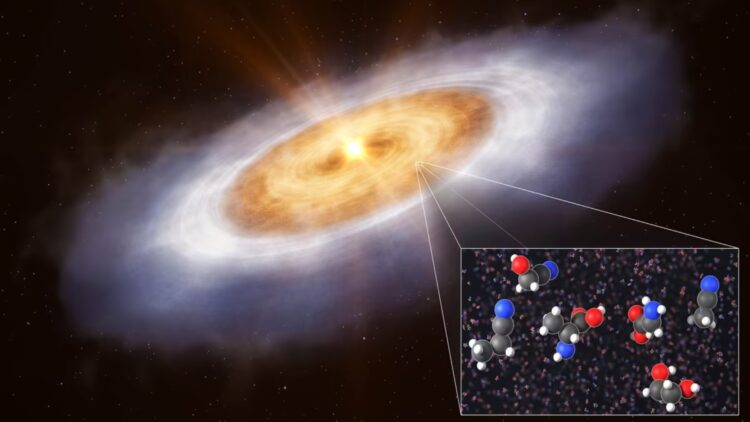
New discovery from NASA! We all know the universe is full of surprises and, every now and then, scientists discover new things that confirm how little we know about it. This time, NASA announced an amazing discovery near the young star V883 Orionis, located inside the famous Orion Nebula–one of the brightest and most active places where new stars are born in our galaxy. So, let’s learn a bit more about what’s out there in the universe, shall we?
The V883 star
This is a protostar, a proto… what? Don’t panic, let’s explain this term in a simple way: it’s a star still in the process of becoming a fully formed star. This type of star is surrounded by a protoplanetary disk made of dust and gas, and this disk is important because this is where planets and moons are formed with the passage of time.
NASA astronomers, using the radiotelescope ALMA in Chile, studied this star because its location and conditions are a unique opportunity to study how planetary systems are born.
Finding 17 complex organic molecules
One of the most remarkable aspects of this discovery was that researchers found 17 complex organic molecules (COMs) moving and orbiting within the protoplanetary disk in the V883 star.
These molecules are particularly interesting because they are similar to compounds we know on Earth like: Ethylene glycol and glycolic acid.
Some of these compounds are precursors to sugars and amino acids, which are essential for life. They are even part of the building blocks of DNA, like adenine, guanine, and cytosine. So, you know now why they are so important.
Why is it so strange?
For NASA, the most surprising thing wasn’t the molecules, but observing how they were floating and orbiting around the star. Something must have pushed them outward and the answer to this is: a percent outburst of energy from the V883. This increase of temperature moved the so-called water snow line, which is the point in the disk where water vapor cools enough to freeze into ice.
When this line moves outward, the heat melts the ice covering the grains of dust and releases the complex organic molecules trapped in them. That’s why the 17 molecules ended up moving around the disk of the star.
The origin of the molecules
Now, the big question for NASA scientists is:
- Were these molecules formed recently in the disk of V883?
- Are they much older, created earlier and preserved in ice since the system’s earliest days?
Solving the mystery of these questions is key because it could explain how basic elements of life appear in young solar systems and how they are part of the formation of the planets.
Importance of this NASA discovery
The presence of COMs in a young star gives us clues about several fundamental issues:
- Planet formation: how disks made of gas and dust around a star contain the materials to make worlds.
- Origin of life: if these molecules are common in the universe, maybe life ‘’ingredients’’ aren’t as strange as we thought.
- New scientific questions: we don’t know yet how certain materials behave under extreme conditions that exist in places like the core of protoplanetary disks.
So, this finding proves, once again, that NASA is widening our knowledge about what happens beyond our planet Earth and allowing us to better understand the universe.
One more step into knowledge
Today we have talked about the young star V883 Orionis and the 17 COMs, and tomorrow we might be talking about another different discovery as mysterious as this one. No matter what it is, the thing is that thanks to technology and observation missions like NASA’s, we can discover never-seen-before phenomena.