
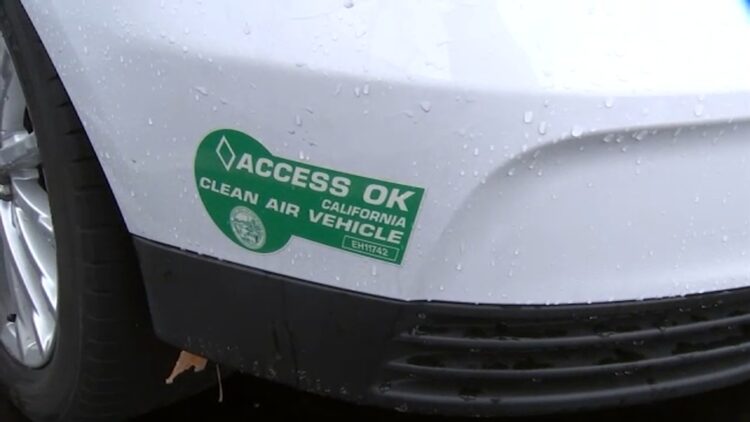
The advantages for users of electric and hybrid vehicles are over. At least, in California, next September 30 will be the last time these cars can drive alone in high occupancy lanes, because that is what they are for, for high occupancy. Starting October 1, the more than half a million drivers with the Clean Air Vehicle (CAV) sticker will lose this benefit and will have to follow the same rules as the rest, uch.
A huge change, because for years this permit was one of the great incentives to switch to a low-emission car, but it is not fair for those who really used that vehicle as high occupancy. And be careful, because anyone who risks using these lanes without meeting the requirements faces fines of up to 490 dollars…
An incentive that marked an era
The CAV program allowed hybrids and electrics for decades to slip into lanes designed for cars with more than one passenger. It was an irresistible hook, especially in places where traffic is terrifying. Many bought models like the Prius just for that quick access to the HOV lane. So much that studies point out that more than half of buyers had it as the main reason. Today, one out of every three electric cars in the entire United States is in California, imagine how strong the measure was in this state!
What changes starting in October
It is over. Starting on the 30th no CAV sticker will be valid, no matter the color, the purchase date or if the car is new. For now, the state has no plans to reactivate the program, and any driver who tries to slip into the HOV lane only with their electric or hybrid will be fined if they do not have high occupancy inside.
What alternatives remain
Carpool! It’s funny, we swear it. On most highways with three occupants you can already use this lane, but there are sections (like the Bay Bridge) that require more passengers, have it in count.
And does public transport ring a bell? Well, that also comes into the equation. BART and AC Transit have adjusted routes and schedules, and in the Bay Area the “casual carpool” has returned, a community system to organize shared rides without too much bureaucracy. Also, the Express Lanes offer discounts of up to 50% to those who meet certain income requirements, there’s no excuses, my friend.
The impact of the program
This exclusive lane was the key for California to be filled with electric or hybrid vehicles, which, hey, is very good. But at the end of the day, a lane intended to avoid lines and traffic jams ended up being the same as always.
Research from the University of Southern California indicates that in areas with a majority of these cars there are lower levels of nitrogen dioxide, and therefore, they have better air quality!
But not everything is positive, experts warn that measuring the long-term environmental benefit is very complicated and that the economic factor played an important role because the areas with more electric cars usually coincide with the richest ones, something very strange, right? (that was irony).
Bye, bye, CAV.
The end of the CAV program closes a key chapter in California’s environmental policy. For years it was an incredible incentive to push the transition towards low-emission cars, but now it disappears leaving a question: was it enough to achieve a lasting change or just a temporary patch that bought time?
The only sure thing is that, starting in October, drivers will have to adapt to new rules and rethink how to move in a state, good luck.