
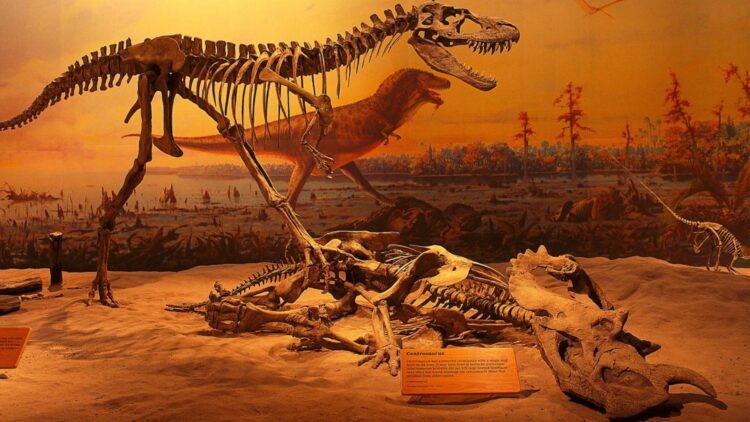
A new geological finding proves that dinosaurs extinction not only was the end of an era, but also remodeled the Earth’s landscapes. When studying sediments in North America, scientists discovered that, after dinosaurs disappeared 66 million years ago, rivers stabilized, soils changed, and forests spread into areas that had once been open and swampy. So, let’s learn more about this.
Dinosaurs as ecosystem engineers
The main idea of this investigation is clear and powerful: not only dinosaurs inhabited the planet, but also they molded it. Because of their size and their eating habits, they kept landscapes open. How? By trampling the ground, eating plants, and knocking down young trees, the dinosaurs prevented forests from becoming too dense. Also, the world they lived in was one of wide, open spaces, unstable rivers, and swampy soils.
Geological evidence confirm this: in the dinosaur era, rivers were unstable, with narrow channels, and frequent flooding. Sediments were moved easily, and floodplains collected mud and silt in abundance.
The day after dinosaurs disappeared
The Chicxulub asteroid impact caused the extinction of the dinosaurs, and this led to the vanishing of the main force that kept landscapes open so:
- Trees grew freely, turning open spaces into dense forests.
- Roots held the soil together, reinforcing riverbanks.
- Rivers that once spread out randomly began to flow in clear, winding paths.
Do you know what? The rocks are the ones where this change can be found. For example, in the Cretaceous layers, scientists found thin sandstones, swampy soils, and messy sediments. But in the Paleogene layers that came after the extinction, the deposits are more organized, the colors are brighter, and there is lignite — a soft coal made from plants. At the same boundary, scientists also found iridium, a rare metal on Earth but common in asteroids. Its presence is strong evidence of the asteroid impact.
Iridium
To confirm the exact moment of this change, researchers looked for a special clue: iridium, which is rare on Earth, but it’s seen a lot in meteorites. After the impact of the asteroid, a thin layer of iridium was all over the planet.
In places like the Bighorn Basin and the Williston Basin, scientists discovered this layer exactly at the boundary where the messy sediments of the Cretaceous change into the more stable deposits of the Paleogene. This shows that the transformation began immediately after the dinosaurs went extinct.
Life that shapes the planet
This finding changes the way we understand the relationship between life and landscape because science used to explain ecological transformations through external factors: climate, volcanic activity, or tectonic movement. However, now this study reveals that sometimes life itself is the one reshaping the planet.
Lesson to have in mind today
Even though this event happened 66 million years ago, its lesson is still relevant today. The extinction of the dinosaurs shows that when key species vanish, ecosystems can shift in sudden and dramatic ways. Now, it is plants and animals that face the risk of extinction, and just like in the past, their loss could deeply transform the planet’s landscapes.
So…
We shouldn’t identify the extinction of the dinosaurs as just the end of an era because it was also the beginning of major changes in Earth’s landscapes. This reminds us that life is what shapes the planet, and the mark of the dinosaurs is still preserved in the rocks beneath us.
Isn’t it amazing that here we are in 2025, still talking about these ancient creatures and their impact on our world? Their story shows us how much we can learn from the past. That’s why we should never ignore history — it teaches us how to respond when similar challenges appear in our own time.