
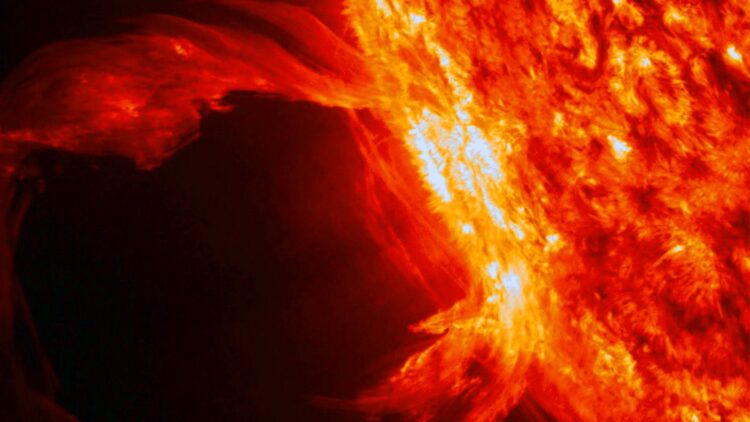
For years, scientists thought the Sun was entering a quiet stage which is probably the quietest in history. In 2008, the solar activity reached the lowest levels ever seen, and it seemed like it would be like that for decades. However, a new NASA study proves the opposite: from this year, the Sun is ‘’waking up’’ and it’s showing more activity each time. So, let’s find out more about this.
Solar cycles
The Sun doesn’t always behave the same, its activity goes up and down in cycles that last about 11 years. One way to see this is through sunspots, which are dark areas that show up on its surface and indicate regions with strong magnetic fields.
Apart from these short cycles, there are also longer changes that can last decades. From the 80s to 2008, the solar activity had been lowering step by step until reaching what experts called ‘’deep solar minimum’’. Everything seemed to indicate that we were entering a historic stage of calmness.
An unexpected change
Instead of continuing with this tendency, the Sun surprised everybody. The study published in The Astrophysical Journal Letters shows that, since 2008, phenomena like solar wind, plasma, and magnetic fields have been increasing.
As Jamie Jasinski, main author of the study in NASA’s Jet Propulsion Laboratory, explained: “All signs were pointing to the Sun going into a prolonged phase of low activity. So it was a surprise to see that trend reversed. The Sun is slowly waking up.”
Importance of this
When the Sun is more active, it produces what’s known as space weather which includes:
- Solar flares: bursts of intense radiation.
- Coronal mass ejections: giant bubbles of plasma shot out into space.
- Solar storms: disturbances caused by streams of charged particles.
These phenomena can also affect satellites, GPS communications, radio signals, power grids on Earth, and even the safety of astronauts. That’s why NASA is closely tracking the solar activity in order to anticipate and reduce the effects of these alterations.
The Sun’s history
The Sun’s monitoring started in the 17th century, when astronomers like Galileo began to count sunspots. These records proved that there are stages with a lot of activity and others much quieter.
The quietest stages recorded were between 1645 and 1715 (about 70 years) and between 1790 and 1830 (about 40 years). Today, scientists don’t exactly know yet why these long periods of calm happened.
25 years before 2008, the sunspots and the solar wind both decreased which led us to think that we were entering another stage of low activity. However, the Sun intensified again.
How NASA studies the star
To reach these conclusions, researchers analyzed data from several NASA missions like Advanced Composition Explorer (ACE) and Wind, launched in the 90s. These spacecraft register data about the plasma, particles, and magnetic fields that our star sends to Earth.
The analysis was based on the platform OMNIWeb Plus, managed by NASA’s Goddard Space Flight Center, which collects data from multiple missions to better understand solar activity.
Looking ahead
Understanding the Sun is key to protecting Earth and astronauts. The solar activity influences magnetospheres, these ‘’bubbles’’ protect planets from harmful radiation. When the Sun is more active, these protective shields can be compressed, leaving planets more exposed.
This is why NASA prepares new missions like IMAP (interstellar Mapping and Acceleration Probe) and the Carruthers Geocorona Observatory, to help improve predictions about space weather.
So, all of this is a reminder that what’s happening in our star is not something far from us since its changes can affect our technology, the energy we use everyday and the safety of those who travel beyond Earth.