
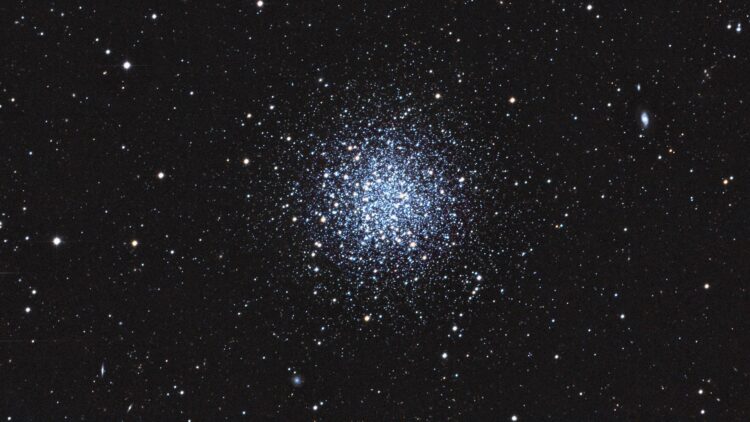
The stellar mystery is solved! After more than 4 centuries, astronomers have tried to solve a huge stellar mystery: how globular clusters are formed. Everything started in 1665, when the German astronomer Abraham Ihle observed for the first time a cluster in the Scorpion constellation. That object, today called M22, became the first globular cluster registered by science.
Since then, these ancient stellar systems have been a constant challenge because they are compact, are billions of years old, and have millions of stars, but they don’t show any dark matter signs. Opposite to them, dwarf galaxies, which have a similar size, are dominated by this mysterious invisible substance.
Now, an international team of researchers from Surrey University seem to have solved this stellar puzzle. Thanks to advanced simulations, they could recreate how globular clusters were born and they also discovered a new type of stellar system with dark matter that may be hidden in the Milky Way. Let’s learn more about this incredible discovery.
The stellar mystery of globular clusters
Globular clusters are compacted spheres with hundreds of thousand or even million stars. Most of them are extremely ancient with ages near 13,000 million years old! The thing is that, while globular clusters seem to lack dark matter, dwarf galaxies do have it and a huge amount. So, this led to two important questions:
- How could the universe create two stellar systems of similar size but with such different properties?
- Could there be intermediate objects that blur the line between globular clusters and dwarf galaxies?
For centuries, there were a lot of theories and also contradictory, but none of them explained all the observed cases.
EDGE
To solve the mystery, scientists used EDGE (Engineering Dwarfs at Galaxy formation’s Edge) which is a cutting-edge set of cosmological simulations. These simulations, made in the DiRAC supercomputer from the United Kingdom, achieved such a high resolution that allowed following even individual effects of supernovas.
The striking thing about this is that both globular clusters with no dark matter and dwarf galaxies full of dark matter appeared in a natural way, without forcing them. What’s more, the third category of stellar systems was created.
GCDs
Researchers called these objects GCDs (Globular Cluster-like Dwarfs). They are systems with properties between globular clusters and dwarf galaxies. Let’s see some features:
- From Earth, they may look like ordinary stellar clusters.
- Inside, they contain dark matter, unlike normal globular clusters.
- They form in very small dark matter halos before cosmic reionization.
- Their stellar history is short: one rapid burst of star formation, then shutdown caused by supernova feedback.
The GCDs are particularly interesting because they can have stars without metals, formed by the primordial gas of the universe. So, detecting these stars would be like finding stellar fossils that reveal the first stages of the cosmos. When it comes to their size and structure:
- Their size ranges from 10 to 60 parsecs.
- Their mass-to-light ratio is higher than globular clusters but lower than dwarf galaxies.
- Their metallicity is extremely low, with [Fe/H] values under –2.75.
Hidden in the Milky Way
The study suggests that some already known objects could actually be GCDs wrongly classified. Among them there are satellites like Reticulum II, Boötes II, Draco II or Eridanus III. These stellar systems seem like globular clusters, but their chemical properties and dynamics coincide with what’s expected from a GCD.
So, it’s possible that these systems could have been ‘’hidden in plain sight’’ in the Milky Way, and confused with other more common stellar clusters.
Stellar implications for dark matter research
The discovery of the GCDs solves part of the stellar mystery about the origin of globular clusters and it also offers a new tool to study dark matter. The study suggests that the existence of these objects depends on the type of dark matter particle. A thermal particle with a mass of around 10 keV would be enough to prevent their formation.
This makes GCDs one of the most sensitive probes yet proposed for distinguishing between warm, cold, or hot dark matter models. At the same time, their stellar populations offer ideal conditions to search for Population III stars, the very first generation of stars in the universe.
Aren’t you surprised every time there’s a new discovery about space? They are so exciting and mysterious that it makes us think a lot about the universe.