
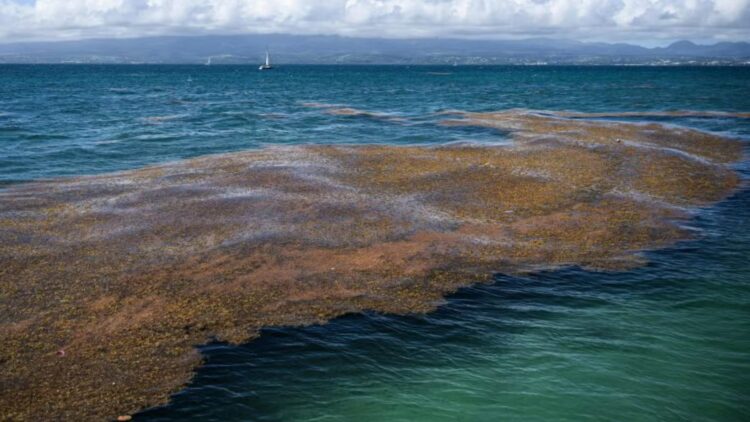
Since a few years ago, scientists have been observing something strange happening in the Atlantic Ocean. They saw a huge brown layer spreading through the water, and it’s getting bigger every year. This phenomenon is known as the Great Atlantic Sargassum Belt, and it’s so big that it can be seen from space.
At first glance, this seems like nothing, just algae floating on the sea. However, its size and its impact are alarming the scientific community. It could release greenhouse gases, affect marine life, and cause problems to coastal communities. The most striking thing is that, even though it’s speeding up due to human action, it wasn’t a phenomenon caused directly by us. So, let’s learn more about this.
The Great Atlantic Sargassum Belt
This is a huge accumulation of marine algae that float on the ocean’s surface. This type of algae, called sargassum, used to be found only on certain areas of the sea known as Sargasso Sea, located in the center of the Atlantic.
Fifteen years ago, sargassum was a bit less common out of that region, but, today, it has become a huge line that crosses the Atlantic from the West coast of Africa to the Gulf of Mexico.
In May of 2025, satellites registered about 37.5 million tones of sargassum forming a line of more than 8,800 km long. To be able to imagine it, let’s take this example: it is double the width of the continental United States.
Why is it growing so much?
A study published in Harmful Algae magazine, and made by scientists from the Florida Atlantic University Harbor Branch Oceanographic Institute, analyzed 40 years of data including: satellite images, water samples, and chemical data. The result? Since 20011, sargassum blooms have been increasing almost every year.
The main reason is related to the increase of nutrients in the water. Between 1980 and 2020, the levels of nitrogen in algae were 55% higher, and the nitrogen and phosphorus increased 50%. This changed was due to:
- Agricultural runoff (fertilizers and chemicals washed from farms into rivers).
- Wastewater (sewage and pollution entering the sea).
- Atmospheric deposits (particles that fall from the air into the water).
The Amazon River also plays an important role because during rain seasons, it sends nutrient-rich water into the Atlantic, feeding the seaweed and helping it grow faster. During dry seasons, when there’s less flow, the blooms slow down.
When sargassum becomes a threat
In small amounts, sargassum is a good thing. The National Oceanic and Atmospheric Administration (NOAA), considers it an essential habitat for more than 100 marine species because many turtles, fish, and other organisms depend on it.
However, when it shows up in excess, it becomes a serious issue. When massive amounts of sargassum reach the coasts or remain floating on the sea, can cause several problems:
- The seaweed rots, releasing a toxic gas called hydrogen sulfide.
- It blocks sunlight, hurting coral reefs and other marine plants.
- It uses up oxygen, creating “dead zones” where fish can’t live.
- It also emits methane and other greenhouse gases, worsening the climate crisis.
Human impact on the Atlantic coasts
Communities near the Atlantic coast, especially in the Caribbean and the Gulf of Mexico, since they know it first-hand. Each summer, tons of sargassum cover beaches affecting tourism and local economies.
Cleaning algae costs millions of dollars every year. What’s more, in 1991, a massive accumulation of sargassum even provoked the temporary closure of a nuclear plant in Florida because algae blocked its water intake system.
Importance of this
Carried by ocean currents such as the Gulf Stream, the Great Atlantic Sargassum Belt has become a serious environmental and economic challenge. Scientists warn that if countries don’t work together —by improving pollution control, managing wastewater, and creating better forecasting systems— the situation will only get worse.
Researchers are still studying what this means for the long-term health of the Atlantic Ocean, but one thing is already clear: the balance of marine ecosystems is changing.