
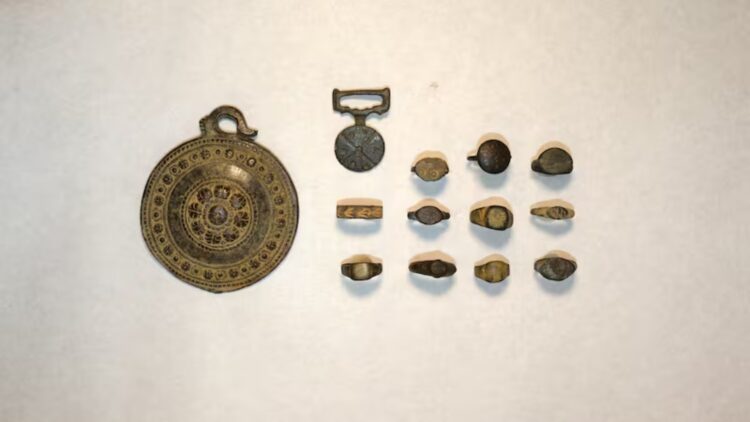
There have been many mysteries hidden, but today some rings (among many other jewelry) have caught the attention of archaeologists. This happened in Chilliwack, a quiet city in British Columbia (Canada), where a surprising finding changed the way of a simple second-hand store.
This store was run by a local charity called Thrifty Boutique, and someone gave a box full of old jewelry. They seemed like ancient decorations without any value, so the volunteers put them back on sale for about 30 Canadian dollars each. Of course, nobody expected that among those pieces could have been a small treasure: 11 rings and 2 medallions that could be more than a thousand years old. So, let’s learn more about this finding.
From the second-hand store to the museum
A client that knew about archaeology was the one who realized that those jewelry weren’t just simply old, he recognized certain designs and materials on the rings and the medallions that looked way older than normal.
Thanks to his warning, the pieces didn’t get lost or were resold, but they were given to the Museum of Archaeology and Ethnology at Simon Fraser University (SFU). There, a group of researchers started an investigation to find where these rings and medallions came from, who made them and how they reached Canada.
Why are these rings and medallions special?
According to the first observations, the rings and the medallions could date back to the 4th or 5th century, which means the end of the Roman Empire or the beginning of the Middle Ages. This would make these pieces of great historic value.
Some medallions have religious symbols engraved and the rings have floral patterns carved into them. Everything seems to indicate they were made more than 1,500 years ago, but nobody knows how they ended up in a Canadian store, nor who donated them.
What’s more, there’s the possibility that all the pieces don’t come from the same place because, maybe, someone gathered them over time as part of a private collection. Then, this person eventually donated them anonymously.
Many questions about these pieces
Researchers at the SFU, along with archaeology students, are using microscopes, mass spectrometry, and metal analysis to study the collection. Also, these mysterious jewelry will be used as the basis for a special university course that will explore both the scientific aspects and the ethical dilemmas surrounding the discovery. So, some of the questions they will try to answer are:
- Should a museum preserve objects whose origin is unknown?
- What if the pieces were stolen or taken illegally from another country?
- And what does it mean, ethically, to display or research something without knowing where it really comes from?
This finding has become an opportunity to reflect on heritage, history, and responsibility.
A difficult decision
The SFU doesn’t normally accept objects whose origin is not clear because this could have moral and legal risks, since these pieces could be stolen, trafficked, or fake artifacts.
However, this time they decided to make an exception. Rejecting the pieces would mean losing them on the black market. So, by keeping them, they can study them and give them an educational value. This way, students can take part in the project to learn about archaeology and how to deal with ancient objects in a responsible way.
Authentic or fake?
This is one of the most important questions, and some clues point out they are authentic. For example, one of the medallions has a Christian chi-rho symbol, which is typical from the Roman era. And the rings? They also have surface details and craftsmanship that seem genuinely ancient.
Still, experts must perform metal and carbon tests to be sure. There’s even a chance that some pieces are authentic while others are modern reproductions.
Even if they turned out to be forgeries, studying them would still be valuable. It would help researchers understand how fake artifacts are made, sold, and circulated — and why people are still fascinated by them.
For now
If researchers eventually discover where the pieces came from and find out they were removed illegally, Canada will have to return them to their country of origin, following international agreements on cultural heritage.
In the meantime, these ancient rings and medallions will become part of a new university course starting in fall 2026. Students will study them from every angle — scientifically, historically, and ethically. At the end of the course, the university museum will host a special exhibition to share what was discovered… and what remains unknown.