
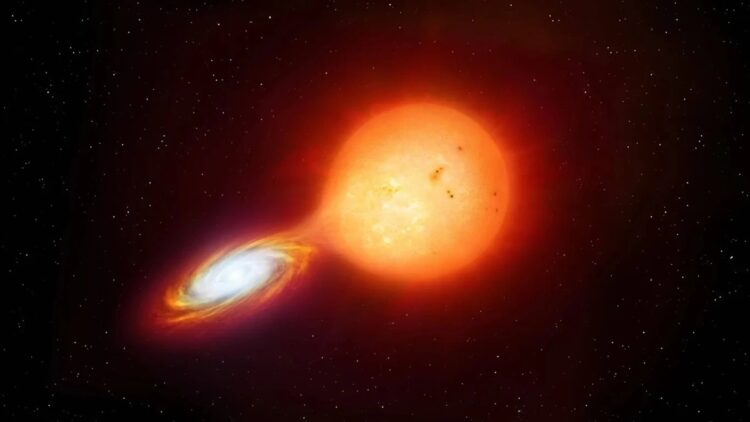
T Coronae Borealis is a star that has caught NASA’s attention because of its strange behavior. It’s in the Coronae Borealis constellation and scientists believe it could explode soon. They are not talking about a dangerous explosion for us, but an incredible phenomenon that happens every 80 years more or less, when this star becomes so bright that it could be seen from Earth without telescopes (even though it’s for a short time).
This mysterious star, also known as the Blaze Star, is about 3,000 light years away. This means the light we see from it travelled thousands of years before reaching us. So, let’s learn more about it.
T Coronae Borealis
Astronomers have been observing a T Coronae Borealis (T CrB) because it shows a weird behavior: it sometimes turns off little by little, becoming invisible to the human eye and, then, it releases a huge amount of energy and it turns on with an impressive brightness.
This type of behavior is not very common. In our galaxy, less than a dozen known stars do something similar. T CrB belong to a group called recurrent novae, which are stars that ‘’explode’’ from time to time but they survive to the process and can repeat it after many years.
How does this phenomenon happen?
T Coronae Borealis is not just a star, but two stars that orbit each other. One of them is a red giant, an old and big star; and the other one is a white dwarf, a very small, hot, and dense star.
The white dwarf slowly takes gas from the red giant. This gas accumulates until the pressure and the temperature are so high that it produces a thermonuclear explosion. It’s like if it were a cosmic pressure cooker: it fills too much and ends up exploding, releasing a huge amount of energy and light.
After the explosion, the stars are not destroyed, they simply cool and the cycle starts all over again until a new eruption occurs with the passage of time.
What it will be seen from Earth
Normally, T Coronae Borealis is too weak to be seen at first glance. Its brightness has a +10 magnitude which makes it invisible for us without using any instruments. But, when the explosion occurs, its brightness increases up to +2 magnitude, which means that it will be as bright as the North Star (Polaris).
Any person could see it without telescopes, but just for a short moment. According to astronomer Stephen James O’Meara, when T CrB explodes it will reach Polaris’ brightness. However, that will fade again in less than one day.
To find it in the sky,you will have to look at the Coronae Borealis constellation, a shape of half a moon that it’s found between Boötes and Hercules constellations. If you picture a line between Arcturus (the brightest star in Boötes) and Vega (in Lyra), Coronae Borealis is right in the middle. Also, you can use astronomy apps on your mobile phone to easily find it.
A natural lab in the sky
The next T Coronae Borealis explosion won’t be just an impressive spectacle, but also a unique scientific opportunity. Observing this type of phenomenon helps astronomers understand how stars in binary systems behave and better distinguish between two types of stellar explosions:
- Nova: A temporary increase in brightness caused by a surface explosion on a white dwarf.
- Supernova: The death of a massive star, an enormous explosion so bright it can outshine an entire galaxy.
What’s happening now?
Scientists have been waiting for so long for the next T Coronae Borealis explosion. The last time this happened was in 1946 and there are registers before that, even from the year 1217 when a German monk wrote about ‘’a weak star that shone with a bright light for a while’’.
In 2024, astronomers detected that T CrB suddenly lost its brightness, a classic sign that the explosion is near. Also, they observed, with the Alfred Jensch Telescope in Germany, the white dwarf is accumulating matter faster than usual, which suggests the event could happen at any moment.
So, when this happens we could see a ‘’new star’’ in the cycle for only one night. After that, we’ll have to wait 80 years for this to happen again. Would you like to witness this peculiar phenomenon?