
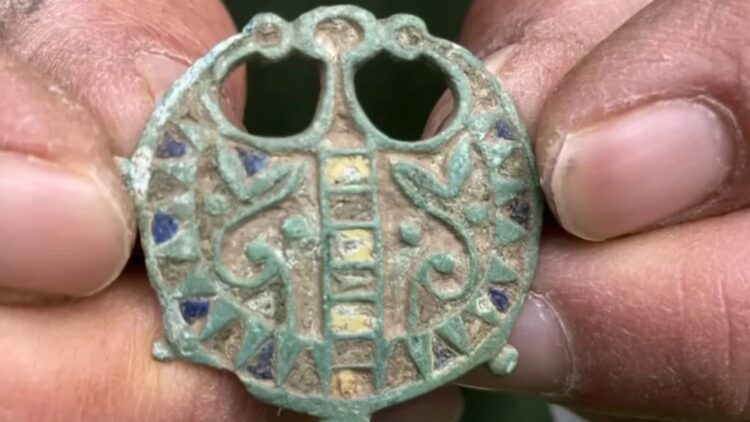
Sometimes the most surprising discoveries happen by chance. Imagine finding a Roman brooch while using your metal detector, you would be surprised and happy, right? Well, let’s not imagine it so much because this is what happened to Martin Williams, a man who loves using metal detectors. He found a 2,000-year-old Roman brooch buried in a field in Dorset, in the southwest of England.
At first, he thought it was a child metallic toy. He had no clue that that small object could change what archaeologists know about the Roman presence in that region. So, let’s find out more information about that brooch, shall we?
An unexpected discovery
Everything started in a freshly plowed field, an apparently normal place without ruins, monuments or any historic sign. According to ancient maps, this place was far from the main Roman routes that crossed ancient Britain.
Martin Williams, who has only been using the metal detector for four years, found a small metallic object buried in the ground. When he unburied it, he thought it was something without value. In fact, he wasn’t that wrong because at that same place he had already found toy cars from the mid 20th century. The object didn’t seem like something special: it was a flat metallic piece with a hinge on the back and a very simple design. Without giving it much thought, Williams dropped it into his bag of scrap metal, where he kept rusty nails and bits of wire that he planned to throw away later.
However, when he arrived home Williams decided to carefully clean the piece and that was the moment when he realized what he had really found. The bronze started to shine and the tiny engravings on its surface appeared. What he had thought was a toy was, in fact, a Roman brooch, around 1,800 to 2,000 years old. It was likely used to fasten a cloak or tunic, and it had remained hidden under the ground for two millennia, waiting for someone to find it.
A rare brooch
The most interesting thing about this finding is not just its antiquity, but the fact that it’s a rare brooch to be found in Dorset. Even though the south of England was strongly influenced by Roman culture after the conquest in 43 AD, the objects usually found there are simpler and more functional.
But, the brooch found by Williams has ornamental details that are more typical of the Gallo-Roman regions — places like modern-day France — or even Rome itself. And this lead us to many questions like:
- Was the brooch brought by a traveler from far away?
- Did it belong to a wealthy Roman citizen or a soldier stationed in the area?
- Could it have been a luxury item obtained through trade or loot?
Although archaeologists don’t yet have clear answers, this discovery shows that Roman influence reached even remote parts of the empire. Nearby, researchers also suspect that there may have once been a medieval church built over an older settlement, suggesting that the land had been used continuously since ancient times.
Treasures under our feet
The Roman brooch in Dorset reminds us that there are still treasures hidden underground. Not only grand Roman villas or tombs, but everyday objects that show how average people lived centuries ago. Among the most important recent discoveries are:
- A hoard of 2,584 Norman silver coins worth more than five million dollars.
- Roman helmets and swords found in Leicestershire.
These finds, often made by amateurs, have greatly expanded our understanding of Britain’s past and enriched museum collections such as those of the British Museum.
British law encourages cooperation between detectorists and archaeologists. Anyone who follows the rules and reports their finds can even receive financial compensation if their discoveries are purchased by public institutions.