
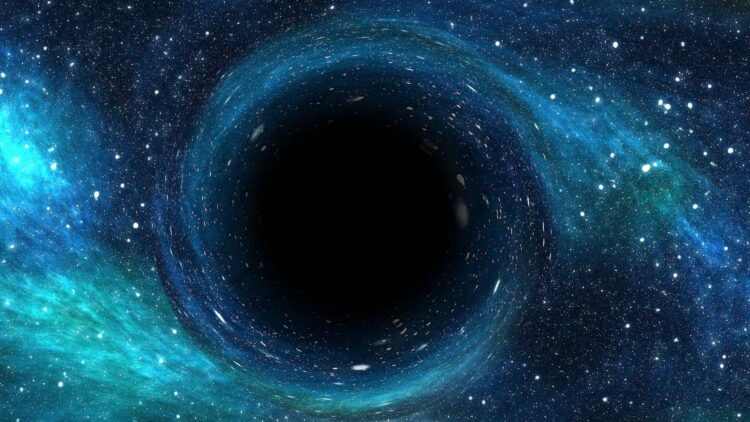
What if I told you there is going to be a cosmic explosion? You might panic and think I’m talking about a science-fiction movie, right? Well, It’s actually happening and a group of scientists say that a small black hole could explode near Earth before 2035. If this happens, it could change what we know about the universe…This idea comes from real physics equations and it could finally prove one of Stephen Hawking’s most popular theories.
According to a new study from the University of Massachusetts Amherst, the explosion wouldn’t be caused by a collision between stars nor a violent event, but in a natural way as part of the cycle of life of a special type of black hole called primordial black hole. Researchers believe that there’s even a 90% chance of us witnessing one of these cosmic events in the next decade! So, let’s find out more about what’s going on out in space.
Primordial black hole
When most people think about a black hole, they picture a giant emptiness in space, a dark force that absorbs everything on its way. The thing is that they are not that wrong because common black holes are born when a huge star dies and collapses under its own weight. However, primordial black holes (PBH) are a completely different story…
These black holes weren’t born from stars, they were formed in the first moments after the Big Bang when the universe was just a fraction of a second of age. At that moment, everything was so dense and chaotic that small concentrations of matter could collapse and create black holes (some of them as small as a mountain or even an atom).
Stephen Hawking discovered that black holes aren’t completely dark, they emit small amounts of energy called Hawking radiation. With the passage of time, this makes them shrink and when a small black hole is left with no energy, it doesn’t slowly disappear: it ends up with a huge explosion of light and radiation–a cosmic explosion.
‘’Dark Charge’’
Until now, scientists thought these tiny black holes should have already exploded a long time ago and disappeared. This is why nobody expected to see one, but this new study suggests a surprising idea: some black holes could have a ‘’dark charge’’. This is not like normal electricity, it only interacts with dark matter (invisible substance that forms most part of the universe, but it doesn’t emit light).
Thanks to this dark charge, a primordial black hole could keep stable for billions of years like a kind of cosmic bacteria that hasn’t discharged yet. At some point, this charge could suddenly release and cause a sudden explosion. So, some of these small black holes could still exist today waiting for the moment to explode.
How would a cosmic explosion like that be seen?
If one of these ancient black holes explodes, we wouldn’t see them at first and we would need telescopes. The explosion would release a short and powerful burst of gamma rays, one of the most energetic types of light in the universe.
Observatories like HAWC in Mexico or LHAASO in China could detect a signal like that if it happens in less than a few astronomical units of distance, which means far for us but very close in cosmic terms.
Detecting an explosion of this type would be a huge discovery because it would confirm that Hawking radiation really exists, proving that black holes can evaporate and die. What’s more, it could reveal new unknown particles, hidden pieces from the cosmic puzzle that forms everything that exists.
A total change in cosmos science
This study is based on complex calculations that combine Einstein’s theory of gravity, quantum physics, and what we know about particles. According to those equations, the odds of witnessing a black hole explosion within the next decade could be higher than 90%.
If it happens, it could rewrite our understanding of the universe. It might show that dark matter has its own form of energy and interaction. It could also give scientists their first real look at how the quantum and cosmic worlds connect — something physicists have dreamed of for decades.
So…
In simple terms, scientists think the universe might be about to give us a front-row seat to one of its deepest secrets. A small, ancient black hole could explode somewhere near us, shining a light — quite literally — on mysteries that have puzzled humans since the dawn of science.
If this prediction is right, the coming years could mark a turning point in our understanding of how everything began and how it all might end. One tiny cosmic explosion could reveal that the universe is far stranger, more mysterious, and more connected than we ever imagined.