
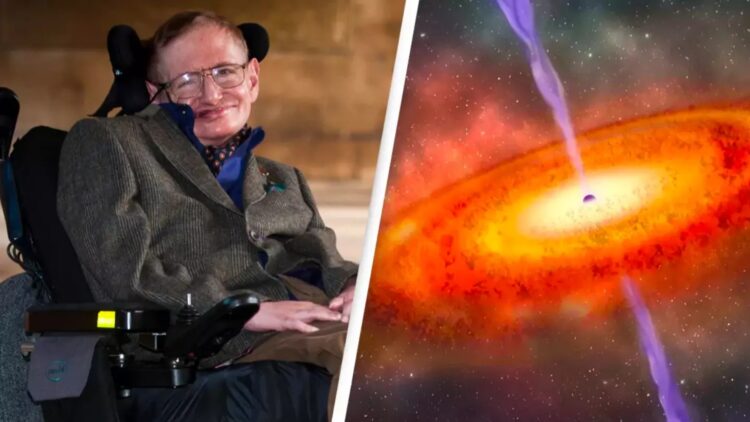
A new discovery could help confirm one of Stephen Hawking’s most famous ideas: Hawking radiation, a faint type of energy that black holes are believed to emit. In an incredible experiment, a group of physicists managed to simulate a black hole in the lab, and to their surprise, it started to glow — just like a real one might.
The study, conducted in 2022 by a team from the University of Amsterdam, used a simple chain of atoms lined up in a straight row to recreate the conditions of a black hole’s event horizon — the invisible boundary beyond which nothing, not even light, can escape.
To the scientists’ amazement, this artificial black hole produced an effect similar to Hawking radiation, offering new insight into one of science’s greatest mysteries: how to connect Einstein’s theory of relativity with quantum mechanics. So, let’s see what they discovered in more detail.
A black hole
This is one of the most extreme and mysterious objects in the universe. It forms when a massive star collapses under its own gravity, squeezing an enormous amount of matter into a tiny space. The gravitational pull inside a black hole is so powerful that nothing can escape it, not even light. That’s why it’s called a “black” hole.
The edge of this cosmic trap is called the event horizon. Everything that passes through it ends up disappearing forever! Nobody knows for sure what happens beyond because there’s no way to directly observe it.
However, in 1974, Stephen Hawking changed our way to understand these mysterious objects forever: he proposed that black holes aren’t completely ‘’black’ since they can emit a slight radiation caused by the effects of quantum mechanics near the event horizon. This energy is known as Hawking radiation and, even though this theory is widely accepted, it could have never been directly detected because the signal would be extremely weak.
The simulation
As observing a real black hole is almost impossible, scientists decided to create an ‘’artificial’’ one to study this phenomenon. The team led by Lotte Mertens used a one-dimensional chain of atoms, where electrons could “hop” from one atom to another. By carefully controlling how easily the electrons moved, the physicists created an artificial event horizon — a point where certain properties of the electrons disappeared, mimicking what happens near a real black hole.
The surprise was when the system started to heat and emit a small amount of radiation, exactly as Stephen Hawking predicted almost 50 years ago.
The result
The observed radiation in that simulation behaved as a thermal energy, similar to heat but it only happened under specific conditions. This suggests that Hawking radiation might only occur in certain situations, when the space-time changes its shape.
The result is important because it offers a way to study Hawking radiation in a controlled environment, without depending on extreme phenomena that happen near a real black hole.
What’s more, scientists noticed this type of radiation only appeared when a part of the system expanded beyond the event horizon. This could mean that the quantum entanglement (the visible connection between particles) plays a key role in its formation.
Stephen Hawking and the future of physics
Stephen Hawking’s work has been essential to understanding how two apparently different worlds connect: the universe of gravity (explained by Einstein) and the universe of particles (explained by quantum mechanics).
Until today, scientists haven’t joined these two theories in one. However, black holes are the point where both cross and this is why studying phenomena like Hawking radiation can make us closer to a unified theory about the universe. So, it seems we are a step further to understand hidden cosmos secrets.