
Sometimes, the greatest discoveries happen by accident and that’s exactly how a medieval treasure was found. The finding took place in Sweden, near Stockholm, when a man went out to look for worms to use as fishing bait.
While digging in the garden of his summer house, the fisherman noticed something metallic buried in the ground: a copper pot filled with thousands of silver coins, rings, necklaces, beads, and other medieval jewelry. So, let’s learn more about this discovery.
The discovery
The finding was officially confirmed by the County Administrative Board of Stockholm (Länsstyrelsen). In an official statement, they described the discovery and announced the start of professional archaeological excavations.
Although the exact number of coins has not yet been determined, researchers estimate that there could be up to 20,000 individual coins, many of them extraordinarily well preserved despite being buried for centuries.
A treasure from medieval times
The coins and jewelry date back to the 12th century, a turbulent period in medieval Scandinavian history. At that time, Sweden was not yet a unified kingdom, but divided into different regions ruled by rival leaders who often fought for power.
Political instability, family conflicts among nobles, and tensions with the Church created an atmosphere of insecurity. Because of that, archaeologists believe that someone buried this treasure to protect it and, for unknown reasons, never came back to recover it.
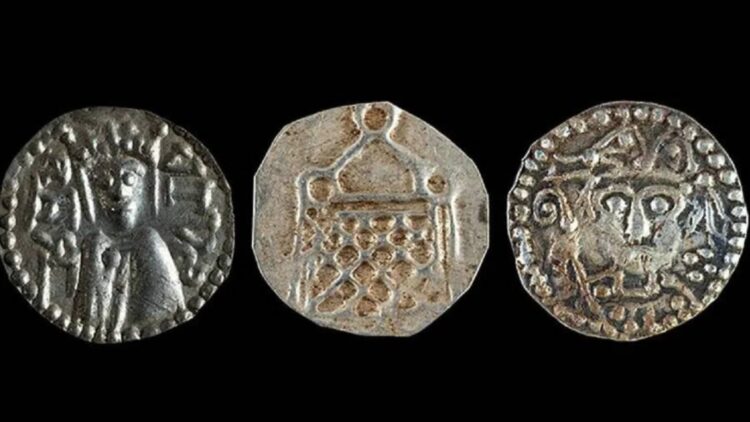
The treasure was stored inside a copper cauldron, which has deteriorated with time but once helped protect the objects from humidity and decay. Inside the vessel, archaeologists found thousands of silver coins, decorative beads, rings, pendants, and several episcopal coins — a rare type of medieval currency minted under the authority of bishops.
The coins of King Knut
Some of the most interesting coins had the word “KANUTUS” written on them. This name refers to King Knut Eriksson, who ruled Sweden from about 1173 to 1195. During his time as king, Sweden started to become more united and built stronger trade connections with Central Europe. That is why some of the coins found in the treasure were made in other countries.
There were also coins made on Gotland, an island that was an important trading center in the Baltic Sea during the medieval period. These discoveries show that the Swedish economy in medieval times was busier and more connected than historians used to think.
Particularly interesting to experts are the so-called “biskopsmynt”, or bishop’s coins, which show an image of a bishop holding a staff or cross. This kind of religious symbol was uncommon on everyday currency and indicates that Church authorities were directly involved in economic matters in some regions.
Who buried the treasure?
Archaeologists believe the person who hid this treasure was not an ordinary villager. It might have been a wealthy merchant, a minor noble, or even a Church official.
The combination of personal jewelry and such a large amount of coins suggests this was a private fortune, carefully hidden during a time of danger or crisis. Whoever buried it likely planned to return, but never did.
A unique medieval find near Stockholm
Even though the treasure was found near Stockholm, it’s important to remember that the city did not yet exist in the 12th century. Stockholm was officially founded later, in 1252, by Birger Jarl, who established it as a defensive and administrative center.
That means this discovery provides a rare glimpse into the area’s medieval past, before the capital even existed. According to the Medieval Museum of Stockholm, this is the first large medieval treasure ever found near the city, making it a key reference for future historical studies.
In addition, the find could help historians better understand the transition from bartering to a money-based economy in medieval Scandinavia. The huge number of coins shows that precious metals were already being used widely for trade, and the variety of coin types suggests that Sweden was connected to a large international trading network across Germany, the Baltic Sea, and southern Europe.
What happens next
Under Swedish law, anyone who discovers historical artifacts must report the find to the authorities. If it’s declared national heritage, the state can keep it and reward the finder.
In this case, the fisherman followed the law and has been praised for his honesty. The National Heritage Board (Riksantikvarieämbetet) will now decide whether the state will officially acquire the treasure.
Meanwhile, a team of archaeologists is carefully documenting and analyzing each piece. You should know that the exact location of the discovery remains secret to prevent looting or damage. Also, experts believe there could still be more buried objects or structures nearby, which could reveal even more about the treasure’s origins. So, who knows if in the near future we’ll hear about another discovery like this?