
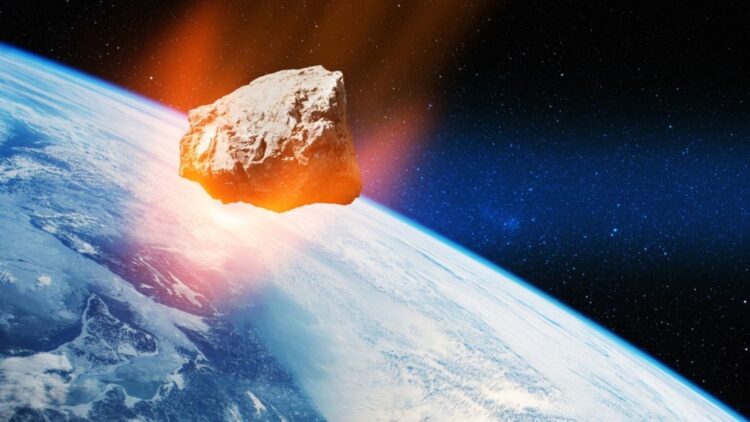
Recently, the Earth had a very close encounter with a small asteroid. You might think this is not something new, but the thing is that nobody saw it coming until it had already happened. This tiny space body passed incredibly close to our planet, almost the same distance as the International Space Station (ISS). According to scientists, it was the second asteroid to be so close that it has ever been registered.
The asteroid, called 2025 TF, passed above Antarctica on Wednesday, October 1, at 00:47:26 UTC; and it came as close as 428 kilometers (or about 266 miles) from the Earth’s surface. To understand how close that is, the ISS orbits Earth between 370 and 460 kilometers. This means the asteroid flew by within the same region where astronauts live and work in space. It was an extremely close call — almost brushing past our planet. So, let’s learn more about this asteroid, shall we?
An inoffensive visitor
Even if the asteroid 2025 TF had hit the Earth, it wouldn’t have caused any harm because it was such a small object (between 1 and 3 meters wide). It’s like the size of a car or a small van. So, if it had entered the atmosphere, it would have almost completely disintegrated leaving a light show on the sky (like a shooting star). The most serious thing that would have happened is that a small piece of the asteroid would have fallen on Antartica’s snow, but that’s all.
What happened after that?
The most striking thing is that scientists didn’t detect the asteroid until it had already happened. The Kitt Peak-Bok Observatory in Arizona was the first to spot it, at 06:36 UTC — about six hours after its closest approach. Later, astronomers checked the data and found that the Catalina Sky Survey had already registered about 2 hours after its closest distance, even though at that moment nobody had noticed its presence.
This proves how difficult it’s to detect such tiny and fast asteroids before they get closer to our planet. They are tiny, dark, and move very fast, making telescopes able to only capture them when it’s too late.
The future of the asteroid 2025 TF
After its short visit, the 2025 TF continued its way toward deep space. However, according to scientists at NASA’s Jet Propulsion Laboratory (JPL), this asteroid will return again in the future, probably In April of 2087.
The great news is that this time it won’t be that close, it will pass about 8 million km of distance (21 times the distance between the Earth and the Moon). Basically, it will be a completely safe encounter.
Why this event is important
Although the 2025 TF was tiny and it didn’t mean any risk, events like this remind scientists that our planet is constantly receiving close visits from space objects. Most of them are tiny and are burned when entering the atmosphere, but every observation helps detection systems and better understand asteroids’ behaviors.
And while this small asteroid drifted away quietly, its visit encourages us to look up at the night sky with curiosity, respect, and wonder. After all, we’re just one small world in an immense universe — and we never know when the next asteroid might swing by to say hello.
So, of course, to know more about these celestial bodies is crucial for the future because the more we know, the more prepared we will be if a bigger asteroid that could be a threat appears someday. Isn’t it incredible the many events that are happening in space while we are here on Earth living our lives?