
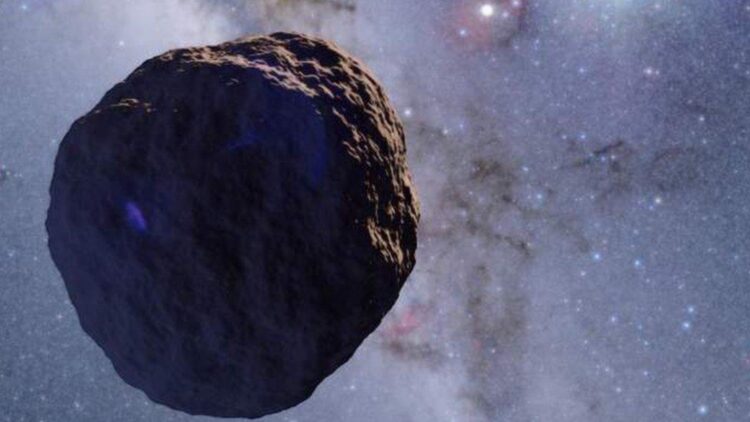
New NASA discovery! You should read this because what the agency has found is something incredible. Have you ever looked at the sky at night and wondered what secrets are hidden among the stars? Recently, NASA has made an extraordinary discovery: a mysterious traveler has entered our solar system and it’s different to everything astronomers have seen before. So, let’s find out more about it.
NASA astronomers find a strange object
Everything started as a normal day for NASA scientists, they constantly observe space to learn more about the universe. While they were studying, they noticed something strange: an unknown object getting closer to our solar system.
At the beginning they thought it could be a comet or an asteroid, since these are the most common objects that get close to Earth. However, something was off because this new object didn’t move like comets or asteroids, it moved in a straight line. This made scientists start investigating its origin.
Normally, objects that enter our solar system come from the Oort Cloud, a very far region beyond Pluto, but the path of this object didn’t match this region. Neither it seemed to come from any known place inside our Milky Way. So, they thought the object came from out of our solar system.
Analyzing its composition
NASA continued studying this mysterious object to understand what it was made of. Its brightness changes while getting closer, which was difficult to analyze. However, by using advanced technology, scientists could examine its atmosphere and composition. The results? It was an exoplanet! This is a planet that orbits a star out of our solar system.
NASA confirmed more than 5,500 exoplanets, but this one was different to the previous ones.
What scientists learnt
The investigation was led by Everett Schlawin from the University of Arizona and Kazumasa Ohno from the National Astronomical Observatory of Japan. Together, along with NASA, used the James Webb Space Telescope to analyze this strange object.
These findings reminded of another known exoplanet, the GJ 1214 b, which was also studied with that same telescope. This planet is about 48 light years from Earth (about 454 billion km) and it’s in a completely different solar system. When scientists analyzed the GJ 1214 b they found its atmosphere was full of carbon dioxide, even more than Venus, one of the hottest planets of our solar system.
In a similar way, when observing the mysterious traveler, they found weak signals that suggest it could also have a rich carbon dioxide atmosphere.
What this means for NASA and science
NASA scientists don’t know yet for sure what this object is or where it came from because it doesn’t fit perfectly in any known category of planets. Some people believe it could be a piece of other solar systems, and, if this is true, this object could help scientists to understand how other solar systems are foe¡rmed and how planets evolve.
Of course, NASA keeps studying it since every new data is a step closer to solve the mystery of this object and know more about the universe surrounding us.
The universe is full of mysteries
For now, the mysterious traveler remains unidentified. It is moving through space at incredible speed and soon, it will likely pass by Earth and disappear into the darkness again.
Even though NASA may never find out exactly what it is, the discovery reminds us of how vast and mysterious the universe is. Our solar system, which we think we know well, is just one tiny part of an enormous cosmic puzzle.
Every discovery like this one helps NASA and other scientists realize that there are countless things we still don’t understand. And each new visitor from space gives us another chance to explore, learn, and be amazed by the beauty and mystery of the universe.