
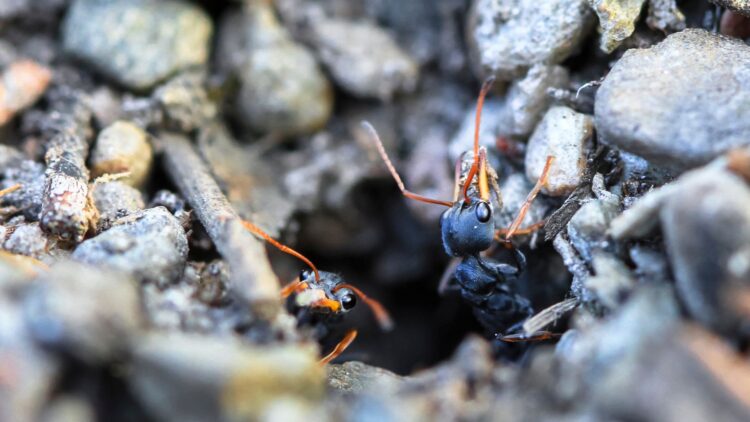
We think of our gardens as safe, quiet places where we can enjoy afternoons lying on the grass, but do we really know what lurks beneath? Now imagine that you suddenly feel an intense pain that leaves you practically breathless. It could be a sting from a “jack jumper”, a type of black ant with an orange jaw that, although very small, is quite dangerous, as its venom and aggressive behaviour make them the terror of gardens in southeastern Australia.
What are jack jumpers?
As we said, they are ants that live in forested regions of Australia. They are called this because they can jump up to 10 centimetres away when they feel threatened, and they are a curious “enemy” of humans and animals, as their poisonous stingers can trigger anaphylaxis.
Where are they usually found?
These little monsters love open areas where the sun shines, such as gardens or patios. According to Simon Grove (entomologist), newly landscaped yards are the preferred place for these ants to build their nests, which usually have between 200 and 1,000 ants, and are usually located near insects, flowers and nectar.
Why are they dangerous?
Because almost 3% of the Tasmanian population is severely allergic to the venom of this insect (although most people will simply suffer pain if they are stung by one). These ants have a poisonous stinger with which they capture their prey.
What else do we know about these ants?
That they have several queens per colony and that each queen, in addition to living for more than 10 years, raises her own offspring. The worker ants (which are all female) live for approximately one year, and the males develop wings and leave the nest when they reach adulthood.
The females have the stinger with which they grab the victim by injecting the poison with the end of their “tails.”
How do you get rid of these nests?
Dr. Grove has given us several tips to follow, and he asks us, please, not to do the technique of pouring gasoline and setting the nest on fire because it is, first, a risk for us, and second because it contaminates the groundwater. So, Dr. Grove advises us to boil water because it is the safest alternative for us and for the environment.
He also gives us the steps to follow.
- First, wait for dusk (or a cold day, because when it’s cold, ants work less).
- Second, scratch the nest mound a little, very carefully! This will expose the holes where the ants hide to sleep.
- Heat the water until it boils and pour it over the nest.
- Scrape the exits as well and pour more water when the ants are coming out.
Although it sounds cruel, it is an effective way to eliminate these ants, although you will most likely have to repeat this action several nights for it to be effective.
Living with jack jumpers
There are many risks associated with these insects, but it is clear that jack jumpers also have their place in the ecosystem. For example, echidnas, immune to their venom, feed on them (and help control their population in this way). But suburban areas cannot be their habitat, these ants are a danger that many prefer to avoid, so it is our job to take measures against these pests
What to do if a jack jumper bites you?
The most important thing is to act quickly. First, wash the area with soap and water to prevent infection. Then, apply a cold compress to reduce swelling. If you begin to feel shortness of breath, dizziness or swelling that does not go down, call emergency services because you could be experiencing an allergic reaction.