
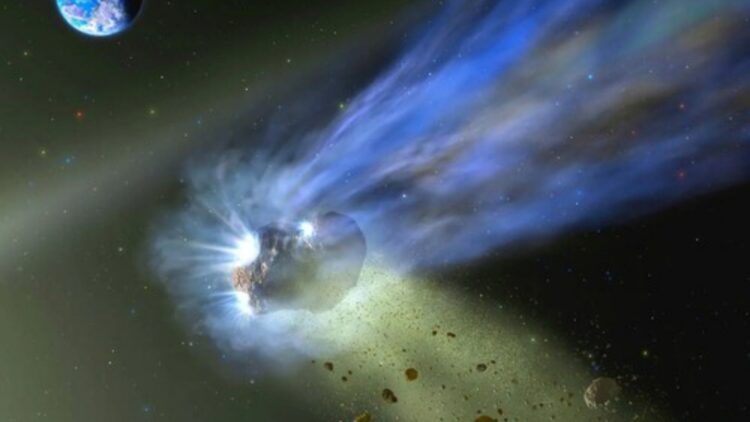
3I/ATLAS has been making headlines for months, but it has been wandering through space for millions of years. Now, thanks to the great James Webb (JWST), astronomers have discovered that this mysterious visitor has completely changed its surface.
It is no longer the same body that left its stellar system millions of years ago because cosmic radiation has shaped it, layer by layer, turning it into a kind of space fossil, and now it is spinning through our system.
A traveler from the cosmos
According to the study published on arXiv, 3I/ATLAS has a thick, hardened crust, the result of more than 7 billion years of constant bombardment by high-energy particles, and it is a very resilient object because it has spent countless millennia being hit by cosmic rays.
While the planets and comets of our solar system live under the Sun’s protective “bubble” (the heliosphere), this interstellar traveler has been completely exposed to the harshness of space, and of course, time and radiation have altered its ice and dust, creating a very dense layer of carbon dioxide on its surface.
Scientists believe the damage extends about 20 meters deep. Beneath that, there may still be an intact core… who knows.
Romain Maggiolo, from the Royal Belgian Institute for Space Aeronomy, said in a statement: “It is very slow, but over billions of years, the effect is very strong”.
What we know
Until now, it was believed that interstellar objects preserved the chemical composition of their system of origin. But no.
3I/ATLAS shows that its journey through space has been enough to completely rewrite its chemistry.
The passage of 3I/ATLAS through our system
It was discovered in July, but this object travels at more than 210,000 km/h, crossing the solar system almost in a straight line.
Its closest point to the Sun was on October 29, and during that approach, its surface began to sublimate (the ice evaporated directly, without becoming liquid).
The curious thing is that the gases released came only from that outer layer “burned” by radiation.
Some scientists hope that the solar heat will erode it enough to reveal part of the original core. Can you imagine it? Being able to observe a region that has remained untouched since its birth billions of years ago!
Older than the Sun itself
Scientists believe that 3I/ATLAS is about 3 billion years older than our solar system, which is hard to believe considering how ancient our system already is. But 3I/ATLAS is one of the oldest objects ever observed.
To better understand its composition, researchers compared it to comet 67P/Churyumov-Gerasimenko (from the Rosetta mission).
They discovered that just one billion years of galactic radiation is enough to form a hardened crust… and 3I/ATLAS has endured more than seven times that period.
What the James Webb shows us
The study “Interstellar Comet 3I/ATLAS: Evidence for Galactic Cosmic Ray Processing” is still under review, but the James Webb made it possible to observe how galactic radiation transforms matter over eons.
A messenger of time
It is mind-blowing for humans to grasp the age of our solar system, truly incredible. 3I/ATLAS is proof that in the universe, nothing remains the same, not stars, not planets, not even the fragments of ice that drift between galaxies!