
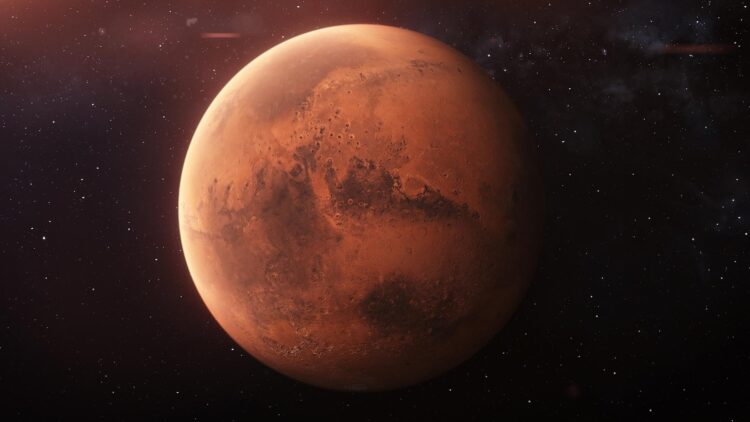
Mars, that beautiful planet that has been the protagonist of many theories and movies, is one of the most interesting places in the solar system. Since human beings could travel to space and the first astronauts reached the Moon, the next big goal has been going to Mars. This happens because Mars could help us understand if there had been life out of Earth in the past. Even though we haven’t reached Mars with people, we know a lot o f important things thanks to the probes and robots sent there.
This planet is also known as the Red Planet, but the name Mars is because the red color reminds people of blood and war. That’s why in Greek mythology it’s related to Ares, the god of war. Then, Romans called it Mars, which is the same god but in their culture. This red color happens because its surface is full of iron oxide, similar to rust that forms when metal oxidizes. So, let’s learn more about this incredible planet.
Mars’ main features
Mars is the fourth planet if we start counting from the Sun and it’s one of the rocky planets like Earth. Although further from the Sun, it’s still our close neighbor in space. However, it’s smaller (about half the size of Earth) and if we look at the sky at night, we could easily recognize it because it’s seen like a bright reddish light.
Despite its red color, it’s not a hot planet. Totally the opposite, it’s very cold, dry, and rocky; but scientists believe that Mars could have been warmer and have liquid water on its surface. This is why, today, they are looking for clues of past life, not current. It’s true that the Red Planet does have water, but most of it is ice and it’s mostly found under the surface and in polar regions. Mars’ atmosphere is too thin to allow liquid water to exist for a very long time on the surface.
What’s more, the Red Planet has seasons as we do on Earth because its axis is tilted. However, each season lasts longer since the martian year lasts 687 Earth days, more than double of one year on our planet.
Last, but not least, the Red Planet has two small moons called Fobos and Deimos, and it’s believed that they were once asteroids trapped due to its gravity.
Mars inside and outside
The inner structure of Mars is similar to Earth’s: it has a metallic core mainly made out of iron, nickel, and sulfur. This core is surrounded by a rocky mantle, and around this we can find the crust which is formed by elements like iron, magnesium, aluminum, calcium, and potassium.
Although we call it the Red Planet, if we looked at it closely we would see colors like beige, gold, brown, and tan. It looks red from far away because of the fine dust rich in iron that covers most of its surface.
It is also a geologically active planet. This means that marsquakes, similar to earthquakes, can occur there. Even though its magnetic field is weak today, Mars once had a stronger one, just like Earth.
This planet also has some very special places, such as:
- Valles Marineris, a huge system of canyons 4,800 km long.
- Olympus Mons, the largest volcano and mountain in the entire solar system, at 22.5 km high.
Its atmosphere
It’s very thin and it’s mainly formed by carbon dioxide, along with some nitrogen and argon. The atmosphere is so thin that it doesn’t protect the surface from solar radiation nor meteorites. This explains why the Red Planet has so many craters, like the Moon.
Mars’ temperatures can vary a lot, they can reach about 20ºC in some parts at day time, but the low up to -153ºC at night or shadow areas. Also, dust storms can happen and they last weeks and cover large regions.
Exploration
Mars’ exploration started in 1964 with the Mariner 4 sonar. Since then, several missions have achieved studying the planet and some of the most important are:
- Viking I and II (1970s)
- Spirit and Opportunity (2003)
- Curiosity (2011)
- Perseverance and Ingenuity (2020)
The biggest goal for the future is to send human beings to Mars, possibly between 2035 and 2045. Wouldn’t it be great?