
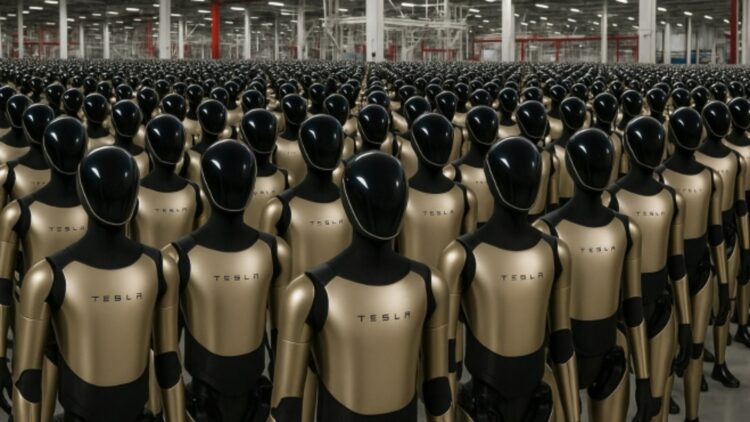
Musk has a new idea (surprise!), and we all know that it translates to “controversy” in absolutely every language. During Tesla’s latest shareholders meeting, he thought it appropriate to claim that prisons could disappear if every convicted person were given a Tesla robot (yes, an Optimus) to accompany them and prevent them from reoffending.
“We could offer a more humane way to control crime. If someone has committed a crime, we could give them a free Optimus to follow them and stop them from committing another crime. There would be no need for prisons” said Musk, as calmly as ever. Wow, this man’s mind deserves a Netflix series.
An idea that sounds more like Black Mirror than public policy, but it perfectly fits his style, he wants to mix technology with ethics. And of course, his dose of provocation is never missing.
From robot to personal guard
Optimus was introduced in 2022, and it has not yet had much presence in the market (let’s say it’s still “very young”), but Musk insists it could become the company’s most valuable product, humanoid robots that can do everything, from household chores to, apparently, watching over ex-convicts.
According to Musk, these robots could follow a person, recognize suspicious behavior, intervene if necessary, and alert authorities. He calls it “technological rehabilitation” but it sounds more like something out of The Sims.
Is it possible?
Technically, it could be possible, sure, but for now, they should first focus on making a robot that can walk without tripping. This robot still doesn’t have real autonomy, and what Musk is doing is what he does best… selling smoke.
And the ethical dilemmas?
Think about it, a robot watching over a human would have to anticipate human behavior, make real-time decisions, and act (without causing harm, of course). Is a robot ready for that? We’d be talking about permanent 24/7 surveillance, with no privacy (not even after serving a sentence!!!).
And many are already calling this a dystopia where punishment doesn’t disappear, it only changes form (and is now managed with an app).
Although Musk has defined himself as a “libertarian,” a “defender of individual freedom” and someone who champions independent thought, there is nothing libertarian or independent about this. His proposal sounds more like a Tesla-sponsored Big Brother than freedom after serving time.
The danger of big tech
These statements have sparked a much broader debate. Is it normal for big tech companies (private ones, of course) to have power over justice or public safety?
Imagine Tesla (a private company) having access to the location, movements, and actions of thousands of citizens “monitored” by its robots.
Who would control whom?
Critics warn about the risk of creating a control society where machines not only carry out orders but also judge. If you’ve seen I, Robot, you know what I’m talking about.
And yes, some defend Musk, believing the current system is expensive and inefficient (because robots that cost $20,000 each and can’t stay upright aren’t, right?).
A world full of robots
It’s Musk’s dream, maybe because he watched too many futuristic movies as a kid, but he dreams of a world where every person has their own domestic robot (just like we all have a smartphone today, for example).
Tesla wants to lead the human-shaped artificial intelligence revolution and will have to compete with OpenAI, Boston Dynamics, Google DeepMind, and others that emerge.
Progress or dystopia?
Musk’s statements are, as always, a cocktail of provocation. But for us, the question is clear: how much of our freedom, privacy, and autonomy are we willing to sacrifice in the name of progress?