
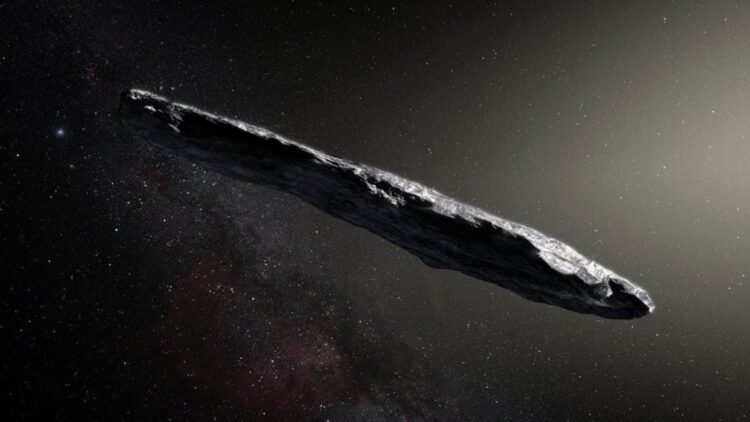
NASA has just confirmed that it has been observing for months an object that does not belong to our solar system. It might seem normal to you, but wait, let us explain. This object is about to cross our system and at a frightening speed, 245,000 km/h, see how now it does get your attention?
Well, it is not a comet, nor an asteroid… They still do not know what it is, although it is believed to be a piece from another solar system, so the opportunity our scientists have to know how other planets form and evolve is unique. It is called A11pl3Z and it will be passing through our solar system all October.
What do we know about A11pl3Z?
That it measures between 10 and 20 kilometers wide, it is one of the largest ever detected, that it moves very fast and that it is not a risk for our planet.
What makes it “interstellar”?
Its hyperbolic trajectory. We explain, unlike celestial bodies that orbit the Sun in closed orbits, this body follows an open path, which reveals that it comes from outside and that it will not be trapped by the Sun’s gravity.
Its behavior does not fit with what we know either, it does not have the bright coma of comets loaded with ice, but it also does not reflect light like a metallic or rocky asteroid. What is it then? It could be an “extinct” comet, a dark asteroid covered with organic compounds or a crusted body that slows down the release of gases, it is still unknown.
Is there risk for Earth?
No! Its trajectory will keep it at a safe distance from us, we cancel planet extinction. All the interest is in the scientific part, not in planetary defense, and on its way it will be observable both from the northern hemisphere and from the south.
What telescopes will follow it?
The international deployment is already being prepared, there will be observations from large aperture ground-based telescopes and also from space platforms, especially in the infrared. What they are looking for: its light curve (shape and rotation), its real brightness and possible traces of gases such as CO or CO₂.
ʻOumuamua and 2I/Borisov
There have already been situations similar to this, for example, in 2017 we saw ʻOumuamua, with its elongated shape and no comet tail. In 2019 it was 2I/Borisov, which did behave like a classic comet, but it was also different
Do they bring ingredients of life?
Well, life itself no, maybe they do come with organic chemistry, like the one recently found on Mars. Complex molecules that bring remains of possible life, we still do not know, there is much to study! For now, we do not have neighbors beyond the confines of our planet.
How it is studied: light, spectra and a lot of patience
The first thing is to measure how its brightness varies to know shape and rotation. Then, separate its light into wavelengths to identify its chemical footprint, ices, gases or organic compounds. If a coma appears, the data will say what happens on its surface. If not, what will have to be done is refine its size and reflectivity.
What does it mean for us?
Research, there are no collision threats, only getting closer to knowing what happens in other parts of this universe so immense that we cannot even imagine.
In the coming months, open data will be released with ephemerides and spectra. There will be preliminary results in the form of preprints and, later, peer-reviewed studies. There will even be space for citizen science: some modest observatories will be able to contribute photometric measurements.