
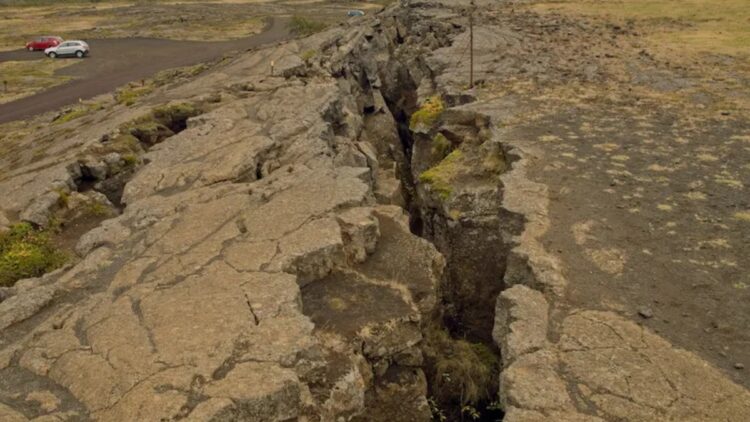
The Earth has never ceased to surprise us. As you may know, originally millions of years ago our planet was organized into a single continent called “Pangea”, and with the breaking up of the tectonic plates and the seismic movement of the Earth’s crust, they began to shift. But that has never stopped, instead the tectonic plates continue to move constantly (that’s why earthquakes occur) and now, in Africa, this same process is happening at a pace that is drawing the attention of the entire scientific community.
Why? Because a new ocean could be created with this widening. We are located in the eastern part of Africa, in the area called the Rift System, which extends from Mozambique to the Red Sea. It was believed that this phenomenon (creating a new ocean or separating the plates) could last more than a million years, but now with this accelerated pace, we could be witnessing a new ocean in record time!
What is happening?
The division of Africa is due to the separation of two key tectonic plates: the African plate and the Somali plate. Now, these plates are moving away from each other at a speed of 0.8 centimetres per year. Although this may not seem like much, the process is so fast that it is unstoppable.
One of the most striking examples of this phenomenon is in the Afar region of Ethiopia, where a 60-kilometre-long and 10-metre-deep fissure has already formed. This geological event is tangible proof that Africa will eventually be separated into two parts by a completely new ocean.
Geology is speeding up in Africa
“We’ve narrowed the time frame down to about a million years, possibly even half that,” says Cynthia Ebinger, a geoscientist at Tulane University. And geology in Africa is not slowing down. In 2005, Ethiopia suffered more than 420 earthquakes in just a few weeks, creating a massive fissure. Something that under other conditions would take centuries happened in just a few days.
And how will the map of Africa change?
As you can understand, absolutely everything will change. The formation of a new ocean will have direct consequences on the economy, ecology and geography of the African continent. Among the possible consequences are:
- New coasts and countries with access to the sea, such as Uganda and Zambia, could have coastlines in the future.
- Ecosystems will be transformed, because new marine species will be formed and local flora and fauna will have to adapt to these new ocean conditions.
- There will be new trade routes and ports that will improve the economic situation of many countries.
- Changes in infrastructure: governments in the region will have to prepare to face changes in topography, earthquakes and a possible reconfiguration of borders.
And in the past?
What is happening in Africa is not new in Earth’s history. Millions of years ago, similar processes led to the formation of the Atlantic and Indian oceans. Now, scientists have a unique opportunity to study in real time how a new ocean is formed, and the community is excited to find out!
Constant evolution and constant movement.
Although it may seem like we are talking about something that happened billions of years ago, today we are seeing two tectonic plates moving apart (just as we are seeing the Eurasian and African tectonic plates coming closer together) and a new ocean could be formed. Perhaps we are not aware of how lucky we will be to be able to see this process in the coming decades, but the transformation will be monumental, and of course, nothing will ever be the same again. Will this be the beginning of Africa’s recovery?