
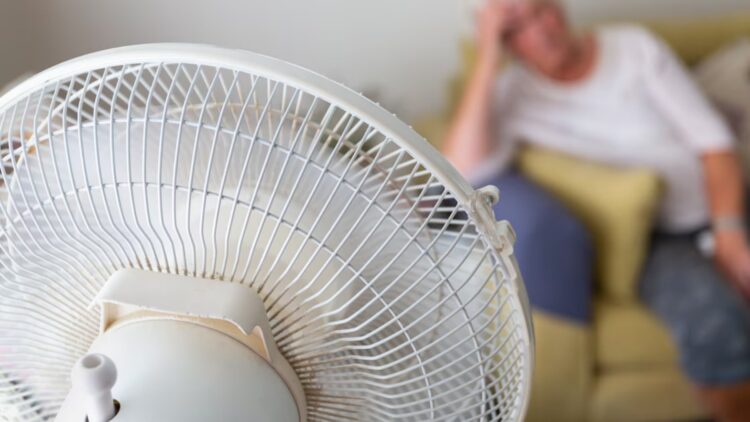
It’s hot, and not just a little, a lot of heat. And yes, we already know it’s summer, but one thing is summer and another is not being able to breathe because of the heat… Meanwhile, our air conditioning bill keeps going up and up… But watch out, these are the moments when our ingenuity sharpens the most, that’s why today we bring you one of those tricks we love. Cool and saves on the bill, what more could you ask for?
It’s called KYL, it was created in Singapore by Aileen Ooi and E Ian Siew and thanks to a physical principle as basic as brilliant, it allows the room temperature to drop without spending a single extra peso!
What is KYL?
A cooling system based on Bernoulli’s principle (the acceleration of a fluid –air– generates a decrease in pressure and temperature). In other words, it’s an invention that is placed on the fan part, and thanks to its design it accelerates the airflow, so the air is much cooler.
How does KYL work and what makes it so special?
KYL transforms a traditional fan into a passive cooling system. At first glance it looks like a funnel nozzle, but in reality it’s an engineering piece that accelerates the air flow, generating a temperature drop of up to 1.5°C.
When air passes through a narrowing (like the KYL funnel), its speed increases and its pressure decreases, creating a natural cooling effect. The best part is that it doesn’t require additional energy, just what the fan already uses, and it also helps reduce humidity in the air.
Installation without complications
That’s the best thing about this invention, that it’s very easy to use and you don’t need any kind of tool or knowledge to have it. It’s attached to the fan using adjustable straps and it doesn’t take more than fifteen seconds to notice its effects, it’s your same old fan, but improved.
Sustainable materials
KYL is made from recyclable materials but that doesn’t mean it will last less, it has high-quality components and can be taken apart, cleaned and reused. Economic and ecological savings!
Can it really replace air conditioning?
It’s not about matching the power of an industrial air conditioner, we’d say that’s practically impossible, but it offers an efficient and sustainable alternative for those who can’t afford the bills during these hot months. In offices, bedrooms or small spaces where the heat hits hard, this is the invention of the year.
How much does a fan consume vs. an air conditioner?
The difference is huge, of course… An air conditioner can reach 1,000 or 2,000 W per hour, while a standing fan usually doesn’t go beyond 80 W per hour…
Not everyone can afford to have air conditioning running all day, so we have to get creative!
Internationally recognized
In 2018, it won the Clean Energy Challenge, organized by the IKEA Foundation and What Design Can Do (WDCD), standing out for its accessible approach and real viability to fight climate change at a domestic scale.
Why should you try it this summer?
Because it’s useful, it’s cheap, it’s easy to set up and it helps protect the environment, aren’t those enough reasons? Less money on your bill and just as cool as if you had an air conditioner running all day!
| Conventional Fan | KYL (Fan Add-on) | Air Conditioner | |
| Cooling Method | Moves air, no actual cooling | Uses Bernoulli effect to lower temp by up to 1.5°C | Uses refrigerant to cool air significantly |
| Energy Use | Low (≈80W/hour) | Same as fan (no extra power needed) | High (≈1000–2000W/hour) |
| Installation | Plug and use | Simple attachment to fan with straps | Complex; may need professional setup |
| Humidity Control | None | Reduces humidity slightly | Often dehumidifies air |
| Environmental Impact | Minimal | Very low; made from recyclable materials | High; uses more energy and refrigerants |
| Cost | Very low | Low-cost add-on | High upfront and long-term running costs |
| Cooling Power | Basic | Moderate – good for small rooms or offices | High – suitable for whole-room cooling |
| Best Use Case | Air circulation | Budget cooling for small spaces and eco-conscious users | Full cooling in very hot or large areas |
| Extra Features | None | Quick setup, washable, reusable, portable | Temperature control, timers, sometimes Wi-Fi |