
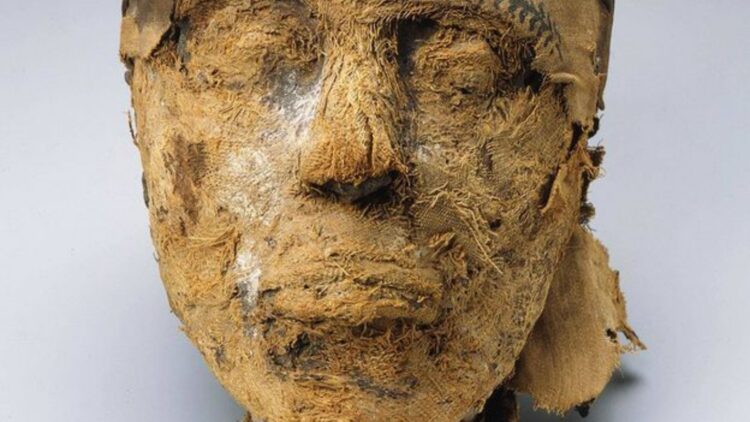
Ancient Egypt is incredible, we know that, But, now, an international team of scientists has managed to sequence for the first time the complete DNA of an individual who lived in the Egypt of the pyramids (wait, what?!!), around 4,800 years ago, and yes, we are going to tell you everything we know about it!
Beyond the conspiranoic theories going around the internet (our favourites, but it’s not the topic here)… he seemed like a common man. 160 cm tall, with signs of having done intense physical work, but he was buried with honours usually reserved for the upper classes.
His genetic material is what surprises the most: his ancestry mixes lineages from North Africa and Western Asia, which suggests that early Egypt was truly a cultural crossroads!
But of course, let’s go step by step: how did a potter end up with a burial fit for the elite? And what does his DNA tell us about the true origin of Egyptian civilization?
An elite burial but.. he worked with his hands
The skeleton was discovered in a rock-cut tomb in the ancient city of Nuwayrat, 265 kilometres at the south of Cairo. The deceased was buried inside a large ceramic jar, and analyses suggest he was between 44 and 64 years old, a very advanced age for the time (especially for someone who had been a labourer).
He suffered from severe arthritis and dental wear, but the most striking part is that his bones showed clear signs of repetitive physical activity: constant movement in the arms, localized wear on the right leg, and expansion in the pelvic bones… So, he was not elite.
For the researchers, everything points to this man working with a potter’s wheel. And yet, he was buried as if he were part of the Egyptian elite. The explanation? He was likely a highly valued craftsman who managed to climb socially (even though that was uncommon at the time).
The genetic analysis of Ancient Egypt
Until now, the heat and dryness of the Egyptian desert had made it almost impossible to recover intact ancient DNA. But thanks to new sequencing techniques, the team at the Francis Crick Institute in the United Kingdom managed to avoid contamination and obtain a complete genome sample.
And that’s how the research teams discovered that 80% of this man’s DNA belonged to North African lineages (the Mesopotamian area) and the other 20% to Western Asian lineages, especially from regions that today correspond to Iraq, Turkey, and Iran. This confirms that Egypt at that time was a meeting point between cultures that brought knowledge, technologies, and genetics!
An ordinary life in an extraordinary era
Isotopic analysis of the molars indicates that the man grew up in the Nile Valley, feeding on wheat, barley, and animal protein, typical products of Egyptian agriculture at the time. Despite his daily routine of manual work, he lived during a time of great transformations: the exact period when the first pyramids were being built.
Also, his survival story is unique. After dying in the 29th century BC, his body was excavated in 1902 and donated to the World Museum in Liverpool. During World War II, most human remains at the museum were destroyed, but his skeleton survived the Blitz bombings, which has allowed us, more than a century later, to know his story with unprecedented precision! A clear example of resilience, don’t you think?
The study has been published in Nature and represents the first complete genome extracted from an individual of Ancient Egypt, opening the door to a deeper understanding of how this legendary civilization was formed!
A single individual is not enough to write the whole story, imagine what it must have meant for this team of researchers to find a biological time capsule!
And in the midst of temples and hieroglyphs, the most revealing story is that of a humble potter who, due to his skill or unexpected social status, ended up buried like a noble! The future of Egyptian archaeology may no longer depend solely on stones, but also on the secrets held in DNA.