
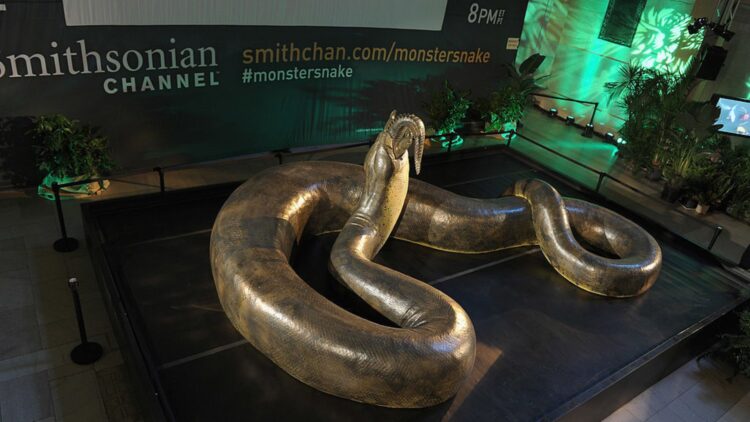
Anacondas are nothing compared to this snake! A new paleontologic discovery has recently been done and has shocked scientists because they have never seen anything like it. We are talking about a snake called Titanoboa cerrejonensis, a prehistoric reptile species from more than 58 million years ago. This caught scientists’ attention because of its size, which makes it the heaviest and largest snake in the world. Yes, even anaconda and python are small next to this ancient reptile.
Modern science is the one in charge of obtaining more details about different fossilized ancient animals. So, let’s see what has been found about this species and the impact in current times,
Titanoboa cerrejonensis
This is the name given to the largest snake ever! You might think of the green anaconda as the largest in the world, but you would be so wrong… The Titanoboa cerrejonensis has always been the owner of that title, but we didn’t know about its existence. This discovery is something to be taken seriously because it changes everything we knew about snakes, climate, and ecosystems in the past.
Place and time
This recently found snake lived between 58 and 60 million years ago in a period called Paleocene, right after dinosaur extinction. This was a crucial time on Earth, full of changes and life starting to evolve again with the appearance of new species in tropical forests.
The Titanoboa cerrejonensis’s remains were found in 2009 in the Cerrejón coal mine, in the north of Colombia. In ancient times, this place was covered by a very warm and humid rainforest which has become this mine a key point for paleontologists since there are many unique fossilized species here.
Size and weight
The Titanoboa cerrejonensis was considered a unique snake among the rest because of its size and weight. Scientists estimate it could be up to 13 or 14 meters long, kind of like a school bus, and it could weigh more than a tonne. So, if we compare it to other regular snakes we are more familiar with, its size is striking. This is why it is the largest and heaviest snake in history.
Hunting
The Titanoboa cerrejonensis didn’t have any venom, so the way it killed its prey was by constriction. This means the snake used its body to strangle it, every time the prey tried to breathe the Titanoboa cerrejonensis choked it a bit more until the animal couldn’t breathe anymore. After this, the snake opened its jaw and swallowed the entire animal, starting with the head.
This reptile’s diet
Scientists thought it only ate big mammals or reptiles, but new research showed this was wrong. After finding more skull bones, it was found that Titanoboa cerrejonensis’ teeth were loose in the jaw which wasn’t common in carnivorous snakes. Can you guess what was eaten by these teeth? Fish!
Thisevidence was crucial to confirm the Titanoboa cerrejonensis was a water snake which mostly lived in the water, like current anacondas.So, it was concluded it mainly ate big fish from rivers and tropical lagoons from the time.
Climate
Of course climate is important in this discovery. Snakes are cold-blooded and they need the environment’s heat to keep active. So, think about how large the Titanoboa cerrejonensis was, its body needed a very high temperature so that it could continue with its life. The perfect temperature for it was between 86ºF and 93ºF, which curiously matches the Paleocene’s tropical climate.
Importance of this finding
This discovery is one of the most shocking in the prehistoric reptile studies because such a large snake has never been seen before. Everything we previously mentioned helps scientists to know more in detail about past ecosystems, understand how life evolved after dinosaurs and how Earth’s climate has changed with the passage of time. So, what might seem like a simple snake, is a huge progress for studies about Earth in the past and now.