
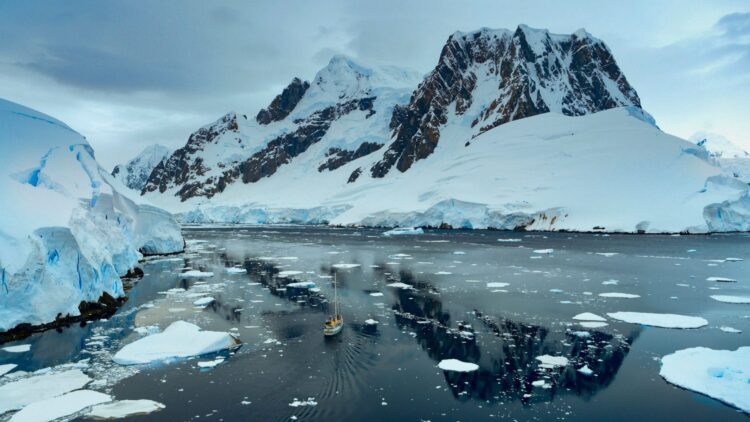
3 kilometres of ice under the Antarctica have something no one expected to find. Not a fossil, not a sleeping volcano, or the remains of a lost civilization. It’s a river landscape!! Ancient, intact, enormous!! And yes, it might be silently helping delay what many fear: the continent’s massive melting and the rise in sea levels.
This discovery was made by British researchers from the British Antarctic Survey, using a radar mounted on a plane. It seemed like a routine flight but it ended up revealing one of the most surprising geological finds of recent years. A frozen place for over 30 million years, is not only still there, but it’s also playing a vital role: it slows the movement of ice.
A river that doesn’t move, but…
It’s a river system about 3,500 kilometers long. Millions of years ago, rivers flowed there just like anywhere else in the world. But when Antarctica separated from Australia and the climate turned it icy, a layer of ice buried everything.
But wait, because the incredible thing is that the ice didn’t destroy it. On the contrary, it preserved it. No rain, no wind, no erosion. As if it had been stored in the planet’s most powerful freezer. And now it turns out that this buried terrain is interfering with the way the ice moves today. It slows it down. It blocks it. It adds resistance.
Why should we care about this?
Because if East Antarctica melts, sea levels would rise more than 50 meters. Not centimetres. Meters. The world map would be redrawn. Cities would be underwater and millions of people would be forced to leave their homes, not to mention the losses… But this landscape acts as a natural brake. It’s rough, uneven, and that creates friction beneath the glaciers, making them slide more slowly.
And even though it may seem incredible, until now almost all studies had focused only on what happens on top of the ice. This discovery forces us to look underneath as well.
Technology that sees through ice
To see what’s under three kilometers of ice, you need more than just determination. In this case, it was achieved using a radar mounted on a Twin Otter plane. It’s a technology that sends signals into the ice and collects the echoes that bounce back from the bottom, allowing scientists to see deep below without digging a single meter.
And what the data revealed wasn’t just a mountain or a crack: it was a piece of Earth’s history perfectly preserved, still influencing the present.
Changing the focus before it’s too late
This discovery reminds us of something we often forget: not everything that matters is visible. Beneath that white frozen mass lies a terrain that has spent millions of years doing its part to keep balance. If that landscape disappears or stops slowing the ice, the pace of melting could skyrocket. And with it, everything else.
That’s why it’s not enough to just look at how much ice melts every year. We also need to understand how that ice moves, why it slows down or speeds up, and what role the hidden structures beneath our feet play.
A reminder buried in ice
This landscape makes no noise, sends no alerts, asks for no attention. But it has spent millions of years doing silent work that now proves crucial. We cannot see it, but it’s still there, quietly holding back climate collapse, like Hodor in Game of Thrones!
So, we can say that Earth had its own defense mechanisms, waiting for us to stop ignoring them! And maybe, just maybe, it’s giving us one last chance to react before that brake disappears and there’s no turning back.