
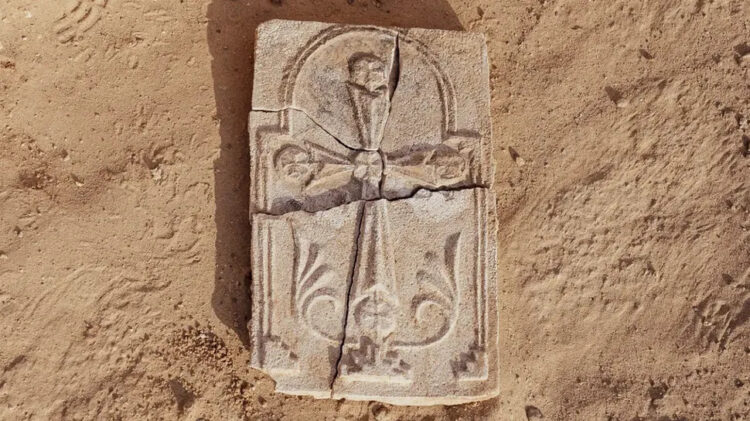
Abu Dhabi is making headlines around the world, and not because it is the place with the most money in the world, but because in Sir Bani Yas, 170 kilometers away, a group of archaeologists has just found a Christian cross, about 30 centimeters in size, buried in a house excavated in the area. It may look like just a piece of plaster but it is the confirmation of the religious history of the Persian Gulf
It was not just an old house
Already in the 1990s, archaeologists had found remains of dwellings and a church on that same island. The problem was that, without clear proof, many preferred not to affirm that it was a Christian monastery. Now there is no doubt. The cross changes everything!
This year’s team came across it in the middle of one of those houses on a wall, visible, as part of the daily life of whoever lived there. According to experts, those houses were small cells where monks secluded themselves to pray in solitude. Then they all gathered in the monastery to celebrate the liturgy. The routine was hard, silent and devoted to faith, but there was no way to be sure that this had really happened.
A piece of history buried in the desert
Sir Bani Yas was one of the points where Christianity took root in the region, back in the 4th to 6th centuries. Long before Islam began its expansion in the 7th century. The coexistence between both religions not only existed: it lasted for centuries, until the monastery was abandoned in the 8th century.
The cross that has just come to light is the missing piece to complete the puzzle and understand how Christians lived in the Gulf, and also to remember that this area was for a long time a place where different cultures and religions shared space.
A monastic life, far from everything
It is not easy to imagine what it was like to leave everything behind more than a thousand years ago to go live in the desert. But that is what these men did. They chose austerity, silence and faith. The houses were minimal, without luxuries, without distractions. Only stone walls, a roof and a cross.
And that is exactly what the cross found represents, a small gesture of faith turned into an archaeological trace. A physical reminder of what they were, how they lived and what they believed. And also, a reminder that Muslims and Christians had and built a society they shared in that same region.
What changes with this?
This discovery validates with tangible proof what before were only theories and connects this island with other communities of the Gulf, and even with the Mediterranean. From here we could begin to talk about routes, shared beliefs, cultural exchange! And it opens the door to a more complete reading of the history of the Emirates, and why not, of the whole Gulf.
History is not linear nor exclusive to a single faith, it is a complex, rich mixture full of nuances. And this piece of stucco, this 30-centimeter cross, proves it completely.
Next stop: Abu Dhabi!
Today, the monastery and its church are open to the public and you can visit it completely, and not only as a tourist attraction. They are there as a bridge between past and present. As an invitation to look back and understand that, long before everything changed, there were already people seeking meaning in their lives among stones, prayers and silence!
“This helps us better understand the nature of life and the relationships that connected the inhabitants of the island with the surrounding region” –Hager Hasan Almenhali,