
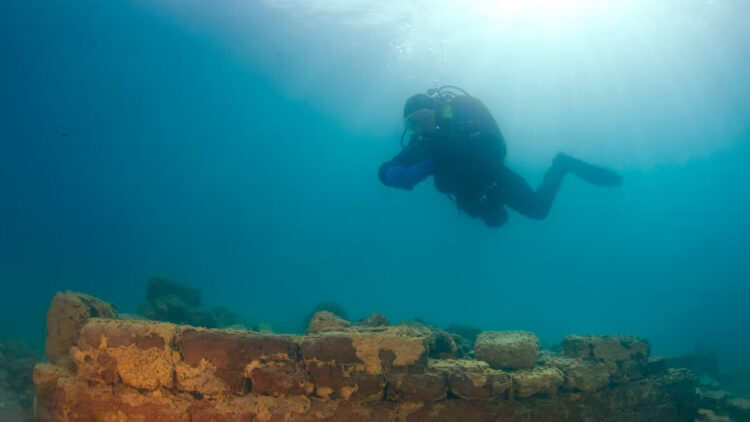
An international team has confirmed that there is a medieval city submerged in a lake in Central Asia, as if taken from a myth, under the waters of Lake Issyk-Kul in Kyrgyzstan it shows us that we knew absolutely nothing about commerce, religion and power in medieval Eurasia!
The discovery
The place is attributed to the Kara-Khanid dynasty, which ruled between the 10th and 15th centuries, when part of the Muslim world was expanding and weaving trade routes in the middle of the Silk Road (towards Asia). And, according to the researchers, the city sank after an earthquake in the 15th century and did not disappear slowly (as some believed), and that made it preserved under the water for centuries, like an unknown Atlantis.
A forgotten city, a huge cemetery, intact construction materials… fragments of daily life that have been frozen in time. All of that is appearing now, piece by piece, to tell us how the people who once called this place “home” lived, traded and died.
A city hidden under the water
The city is located just between one and four meters deep, in an area called Toru-Aygyr, a site occupied long before the arrival of Islam.
There have appeared remains of fired brick constructions, huge pieces of pottery, a mill, decorative fragments, and clear signs that the place had important public spaces such as mosques, religious schools, baths… Imagine walking through a medieval city where almost everything was made with brick, mud and hands, and where commerce marked the rhythm of daily life.
The first analyses suggest that this was not an improvised settlement, but a structured city like the ones we know now.
It disappeared suddenly
According to archaeologists, the rise of the settlement coincides with the power of the Kara-Khanids, a Turkish dynasty key in the expansion of Islam. At some point in the 15th century, a great earthquake shook the region and caused the sinking of a large part of the city.
And that made the city disappear completely, but it is much more intriguing how it has remained intact… Being under water not only protected it (even though it sounds strange because of corrosion), but allowed the recovery of materials with a quality that is rarely seen in land excavations.
A cemetery of stories
Among the most impressive findings there is a huge Islamic cemetery, about 60,000 square meters, of course, the graves are oriented towards Mecca, which confirms the religious character of the community.
The human remains and funerary objects will allow the study of the health, diet and mobility of its inhabitants. Something that, in the context of the Silk Road, could reveal a lot about migration, epidemics, trade and social inequality.
Rescuing an ancient city
To study a site like this, masks and oxygen tanks are not enough, advanced navigation, underwater drilling and a lot of technology are needed to map the place before intervening.
Drones, advanced navigation, underwater drilling: the team is using high-tech tools to map the site before intervening. And thanks to this technology each layer of the city is being recorded, a city that could still remain under the water if nobody had found it.
How do we look at history?
Well now, we place Toru-Aygyr at the center of conversations about cultural and economic exchanges during trade with the Silk Road when it had been believed all this time that it was simply a transit place between two completely different worlds.
A Pompeii under the water?
It is almost what many think, it is incredible how fragile we are (and our cities) that they remain hidden by a natural phenomenon, whether a big wave or a volcano, and leave it buried for centuries…