
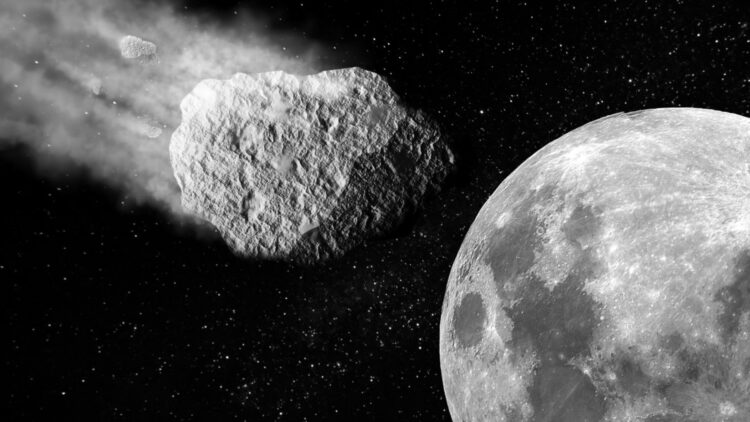
Between 53 and 67 metres has an asteroid that NASA and the European Space Agency have catalogued as 2024 YR4, and they have been monitoring it for the past couple of months. Initially, 2024 YR4 was on a path to impact our planet, but far from that news, it now has a 3.8% probability of hitting the Moon. However, don’t worry, it won’t happen now, it will be in 2032. Although the probability is low, and it doesn’t pose any threat to Earth, the possible impact has sparked interest among the scientific community, not because of the risk, but because it would be the first time we observe live (with a telescope or binoculars) how an object of this size impacts the lunar surface.
The scare that ended up pointing to the Moon
The 2024 YR4 asteroid was discovered last year, and from the very beginning, it caught the attention of experts because it had a 3.1% chance of impacting Earth. For weeks, it was one of the most serious threats ever recorded, not because it would happen like it did with the dinosaurs and devastate everything, but it did have the potential to wipe out entire communities.
After much observation, 2024 YR4 was ruled out as a possible impact, but new measurements from the James Webb Space Telescope recalculated its trajectory. The result: the risk to Earth disappeared completely… and the risk to the Moon increased. In fact, it rose to 3.8%.
Why would an impact on the Moon be so important?
The Moon, unlike Earth, doesn’t have an atmosphere. That’s why it’s so easy for asteroids to leave marks on it. And although it’s full of craters, the possibility of witnessing one live would be a milestone for science.
According to Professor Mark Burchell, even with binoculars, it would be possible to see the moment of impact if it eventually happens. Additionally, it would allow for real-time study of how the lunar surface reacts to such a collision.
So… should we worry?
No. NASA itself has already clarified it: there’s a 96.2% chance that nothing will happen… But the fact that there is a slight chance that it could has put experts on alert.
Just like with the DART mission in 2022, when an asteroid was intentionally deflected, these real-life scenarios serve to test monitoring and planetary defense systems.
What if it hits in the end?
If 2024 YR4 hits the Moon, it will be the first impact of this type observed from Earth. It wouldn’t have consequences for our satellite or for us, but it would allow us to measure material dispersion, crater formation, and the seismic effects of the impact.
Why does NASA and ESA see it as an opportunity?
Because it’s a unique opportunity to study live how an asteroid behaves when it collides with a surface without an atmosphere. There’s no need to send missions or robots: just point a telescope upwards and observe.
Richard Moissl, head of the planetary defence office at the ESA, made it clear: “From a scientific point of view, it’s a very interesting scenario that would provide very valuable information.”
There’s no danger. But there is much to gain if the impact happens. There’s only a 3.8% chance of a collision, but… it’s not something that happens every day! If the asteroid does end up colliding with the Moon, it will be like attending a large-scale natural experiment, visible to everyone.
So, for now, we just have to wait for the days to pass, look at the sky… and keep the binoculars near to you! Will it happens finally?