
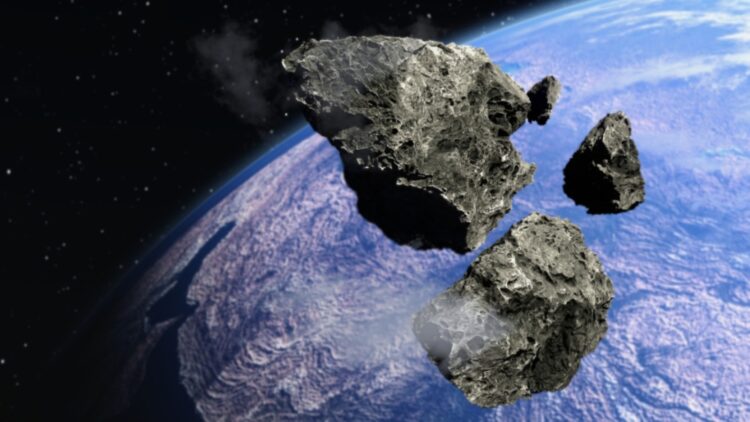
We’ve heard many things about asteroids, but today we are going to tell you very interesting things about ‘’invisible asteroids’’ that could put Earth at risk. Scientists warn about the possibility of the existence of a group of invisible asteroids orbiting near Venus, and some of them could be a threat for Earth in the future. Why? Because these elements from space are extremely difficult to detect since they are located in an area of the Solar System where the sunlight completely hides them.
Basically, we could be ignoring an entire group of asteroids impossible to see with current telescopes due to the solar brightness they hide. So, let’s learn more about them and see what we might be facing in the future.
Why we can’t see these asteroids
To observe them, astronomers would have to look at the Sun because these asteroids orbit nearer it than Earth. However, the sunlight is so intense that the asteroids’ reflection is completely gone, as if we were trying to see a candle lit up at midday. For example, astronomer Valerio Carruba from São Paulo State University in Brazil, explains:
“There’s a population of potentially dangerous asteroids that we can’t detect with current telescopes. These objects orbit the Sun, but not in the asteroid belt between Mars and Jupiter. They’re much closer, in resonance with Venus.”
Because they are so difficult to observe, these Venus co-orbital asteroids could be hiding in plain sight — and some might eventually cross paths with Earth.
What are Venus co-orbital asteroids?
They don’t orbit around Venus, but around the Sun and synchronize. Sometimes they are ahead of the planet, and others behind or even they cross its orbit in very complex trajectories.
Until now, astronomers have identified only 20 asteroids of this type, but scientists believe this is just a small part of the total because there could be more than hundreds. However, the problem is that their orbits are not stable: they are chaotic and constantly change their shapes in relatively short periods of time (about 12,000 years). Scientists can only predict their trajectories precisely up to 150 years toward the future.
This means that, at any moment, an asteroid could exit its stable orbit and move toward Earth, even crossing its trajectory.
How dangerous can they be?
Some of them could have about 300 m of diameter, which would be enough to create a crater of 3 to 4,5 km wide if they crashed against our planet. The impact would release an energy equal to hundreds of megatons, capable of destroying an entire city or provoke a regional disaster. This is why scientists fear the existence of a hidden population of dangerous asteroids, which are unknown and difficult to track, that could head our way.
What makes them so difficult to detect
They have something in common: a high eccentricity, which means their orbits stretched and elongated rather than circular.
For comparison, Earth’s orbit is almost a perfect circle, with an eccentricity of 0.017, while Venus co-orbitals have values above 0.38. Because of this elongated shape, these asteroids sometimes move closer to Earth, which gives astronomers a small window of opportunity to spot them at twilight — when the Sun has set but still lights up nearby objects in space.
Carruba and his team ran computer simulations to explore how these asteroids behave, focusing on those with lower eccentricity — more circular orbits — to see whether they might be hazardous to Earth and whether new telescopes could detect them.
What scientists discovered
Simulations showed that asteroids with more circular orbits (eccentricity below 0.38) could also pose a future threat to Earth. The problem is that even advanced telescopes have difficulties tracking them.
The upcoming Vera Rubin Observatory, which will use the largest space camera ever built, would only be able to detect these asteroids during limited times of the year, when the Sun’s position allows it. That means there are many times when these objects would remain invisible, even to our best telescopes.
This gap in our knowledge makes planetary defense more difficult — it’s hard to prepare for a problem you can’t see.
Any solution?
One solution, scientists suggest, would be to place an observatory in orbit around Venus or near its orbital path. From that position, it would be easier to look outward from the Sun’s direction and detect the asteroids that are currently hidden from Earth’s view.
NASA’s upcoming NEO Surveyor mission could also help. It’s designed to find near-Earth objects in the inner Solar System — including those that are invisible from Earth’s surface.
As the researchers wrote in their paper, “While surveys like those from the Rubin Observatory might detect some of these asteroids, only a space mission near Venus could fully map and discover the remaining invisible potentially hazardous asteroids.”