
Sometimes it seems that we have already seen everything in the Solar System and that after decades of telescopes, probes and missions, anything that could surprise us would already have made headlines… Well, no. It turns out that Uranus has been hiding a moon for almost 40 years.
The new satellite, temporarily named S/2025 U1, is small, dark and not very glamorous, but it achieved something others did not: going unnoticed even when Voyager 2 literally passed in front of it. A moon, 10 km in diameter, was hidden among Uranus’s rings, but… if a moon escaped us, what else is still escaping us?
How do you miss a moon?
Because it is practically invisible, it is in the worst place for someone to see it, right between Uranus’s rings, moving fast and reflecting very little light, so it was normal that Voyager 2, which we cannot forget was the queen of the 80s (but it was the 80s), did what it could with the technology that existed. It was revolutionary for its time, yes, but today we could compare its camera with your 2011 blackberry. It is not that it ignored it, it is that it had no logical way to find something so small and subtle.
Then James Webb shows up and says…
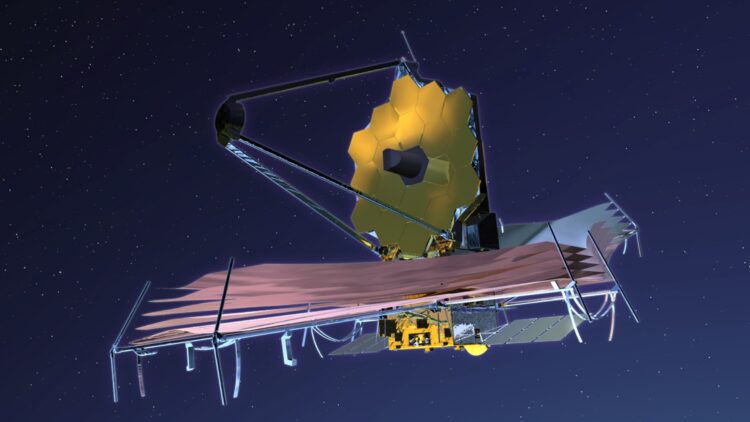
There is something here! In 2024, a team led by researcher Maryame El Moutanid decided to point the James Webb at Uranus, with infrared light, maximum sensitivity and the capacity of this telescope to see where no one else sees. And there it found a small object moving where nothing had been recorded before. At first there were doubts, what will it be? Is it just passing by? But no, it was a new satellite they were discovering at that very moment.
A very small but powerful moon
What is interesting about S/2025 U1 is not what it is, but what it could be doing, and they believe this object works as a “shepherd moon”, similar to the ones Saturn has, small fragments that act like invisible architects, shaping and organizing the rings.
If this is true, Uranus does not have a random ring system (as was believed until now) but a structured one, there could be more hidden moons both in Saturn and in other planets and, of course, Uranus would be much more active in the solar system than we thought.
Mission to Uranus
This discovery has made many return to their desire to send an exclusive mission to Uranus, a serious one, with orbit, with state of the art instruments dedicated to looking at the planet very calmly. The questions remain, where did the moon come from? Was it born from the rings? Or is it part of a larger satellite that broke apart? Is it stable? Could it appear more? The heads of our astronomers do not stop asking themselves questions for which, obviously, they need answers.
And if…?
Until there is a spacecraft flying over Uranus, there is the plan B, simulations. So for the moment there will be digital models to recreate the origin, trajectory and impact of the moon on this planet.
Even if it is a satellite of 10 km, the “small and irrelevant” things are precisely the ones that end up changing everything.
A historical revision
The appearance of S/2025 U1 has forced the reopening of debates we believed closed, such as whether we really know our solar system and above all, how many more things are yet to be discovered!
The message is very simple (and a little unsettling)
S/2025 U1 is small, dark and apparently insignificant, but its existence proves something we should not forget, which is that the universe is light years ahead of us.
We are trying to understand it with tools that, in a few years, will be collector’s items, and if a moon could hide for 40 years being there, calmly orbiting… imagine what is farther, smaller or quieter. And now we ask another question, it is not “how did we not see it before?” but “what are we still not seeing?”