
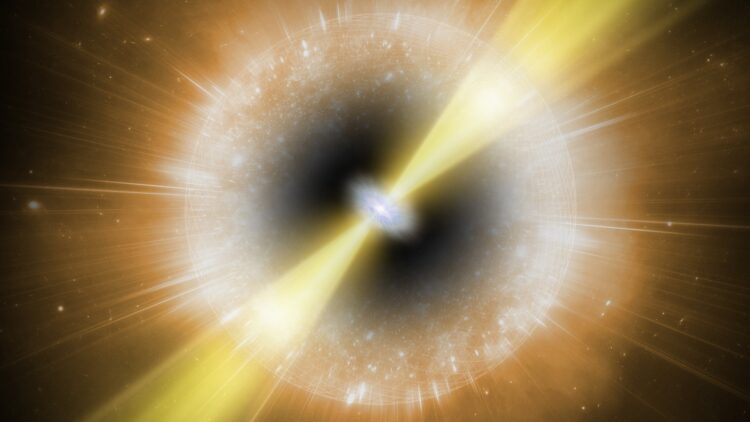
A new study shows that astronomers could be close to witnessing one of the most extraordinary events of the Universe: the explosion of a black hole. According to physicists from the Massachusetts Amherst University, there is a 90% chance of this happening in the next decade and of being able to detect it with current technology.
If this is confirmed, it would be a historic discovery. Not only would it show how black holes die, but also it would provide astronomers with a complete register of all the existing particles (known and unknown). So, let’s find out more about this.
What type of black hole could explode?
The explosions mentioned in the study would come from tiny black holes that remained as left overs from the birth of the universe. They are known as primordial black holes (PBHs).
Opposite to supermassive black holes at the center of the galaxies or stellar black holes formed by collapsing with a star, these would be tiny and with more similar masses to the ones of asteroids than of the Sun’s.
Physicists believe these primordial black holes are formed in the first chaotic moments after the Big Bang. Due to their small size, they would have a much shorter life than big black holes.
Why do black holes die?
Black holes are famous for absorbing everything too near them, but, in 1974, Stephen Hawking proposed something surprising: black holes also emit radiation, now known as Hawking radiation.
This means that a black hole slowly loses mass and, with the passage of time, it would end up completely evaporating. So, the smaller it is, the faster it loses mass. In its last moments, this process speeds up until it ends up being a powerful explosion like a supernova.
For big black holes, this end is very far in the future. However, primordial black hoes, since they are lighter, could be near their last moments right now.
What astronomers would see
The study suggests that when a primordial black hole explodes, it will release all types of fundamental particles like:
- Familiar ones like electrons and neutrons,
- Particles we suspect but have not yet found, such as dark matter,
- Even completely unknown particles we have never dreamed of.
For astronomers, detecting these explosions would be like opening a box with all the basic elements of the universe. As Joaquim Iguaz Juan explains, astrophysicist from the UMass Amherst, an event like this ‘’would completely revolutionize physics and help us rewrite the history of the Universe.’’
Why we haven’t seen one before
Until now, astronomers thought these explosions were extremely rare and happened just once every 100,000 years. But the new analysis suggests that the truth is that it could happen about once every 10 years!
The team also explored why some primordial black holes could keep existing and they propose this answer: ‘’dark electron’’. This is a heavier version of a regular electron and it will provide primordial black holes a kind of hidden electric charge that might delay their evaporation, meaning we haven’t missed all the explosions after all.
In physicists Michael Baker’s words, this model proves that a primordial black hole could ‘’temporary stabilize before it explodes’’.
How astronomers will detect them
The data shows that current gamma ray observatories should be capable of detecting one of these explosions if it happens nearby in the sky. Given the predicted frequency, astronomers expect to see at least one in the next decade. Such a discovery would:
- Confirm the existence of primordial black holes,
- Provide the first direct evidence of Hawking radiation,
- Reveal a complete catalogue of particles that make up the Universe.