
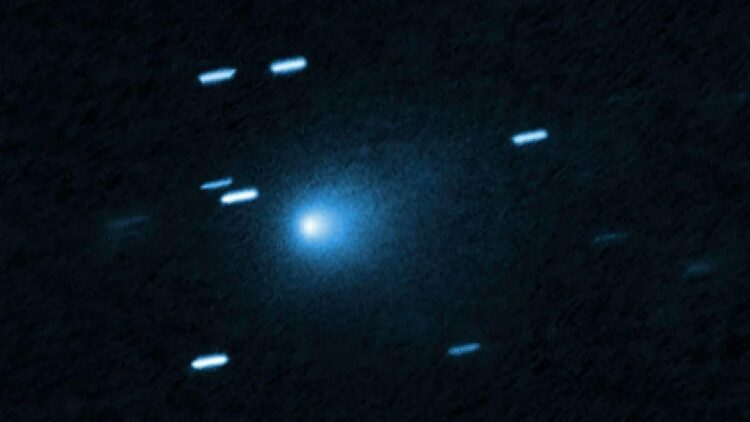
The comet 3I/ATLAS has become a trend again, and scientists from Spain believe it could be a time capsule. This is what Xabier Pérez Couto from the Center for Research in Information and Communication Technologies (CITIC) at the University of A Coruña (Spain) says. He states that they have managed to reconstruct the interstellar comet’s trajectory over 10 million years. Yes, 10 million years, as if they were looking through the past, something incredible (and for us mortals, truly unbelievable).
But wait, that’s not all. According to these researchers, this little traveler was not born in our solar system, but much farther away. What?!
From another corner of the Universe
Yes, although it was first detected on July 1 from Chile (thanks to the ATLAS system – Asteroid Terrestrial-impact Last Alert System), this little friend has many peculiarities, one of them being that it comes from another stellar system.
And that means it is the third interstellar object discovered so far, the other two being the famous ‘Oumuamua and 2I/Borisov, crossing the galaxy until “landing” in our solar system.
But no need to worry, scientists assure that it will not get closer than 270 million kilometers to Earth, so we will be able to observe it calmly and without risk, we are not going to disappear (for now).
“Each interstellar comet is like an open window to the past of the Universe”, explains Pérez Couto. “It allows us to analyze materials formed around other stars, under conditions very different from those of the Sun. It is a unique opportunity”.
Gaia: the star map
To understand where this comet comes from, the researchers used data from the Gaia mission of the European Space Agency (ESA). Gaia is the most precise map of the Milky Way ever created; it measures the position, movement, and brightness of billions of stars.
With that information, the Spanish team was able to “rewind galactic time”, reconstructing the journey of 3I/ATLAS from its origin to its passage through our system.
A time capsule made of ice and dust
Comets have always been considered relics of the past, but interstellar ones like 3I/ATLAS are even more so. They are fragments of the original material from which planets formed around other stars.
Studying them is like analyzing the DNA of other solar systems because they offer clues about how worlds form, which organic compounds appear first, or how the essential minerals for life are born, something that still keeps many of us awake at night.
According to the CITIC team, 3I/ATLAS is a time capsule that preserves within it chemical traces of the primitive space. But what is most surprising is not only its origin; it also challenges human theories about the formation of the solar system and how interstellar materials evolve.
Spain on the front line of international astronomy
Watch out, NASA, because Spanish science is playing in the big leagues of space. From there, the CITIC researchers work with numerical models and simulations that reconstruct trajectories impossible to observe directly.
“What we do is literally rewind time” says one of the team members. “And every time we do it, we discover a new story about how the Universe works”.
The future: beyond the Sun
The ESA and the European scientific community have already confirmed that interstellar objects will be a priority in the coming years because they are messengers from other worlds and other times, and that is something very interesting to study.
This comet will continue on its path once it passes our system, but as they say, a small step for man…
We will keep exploring the sky with the same curiosity as when we looked at the stars for the first time, hoping that this way we can find out how the universe we know today was created!