
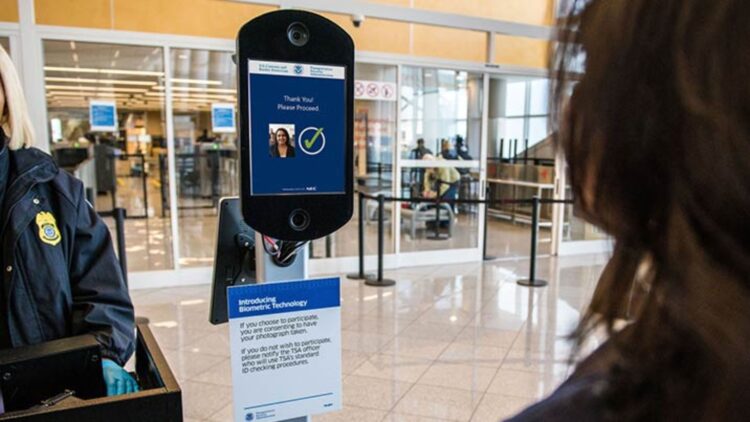
We have heard about some changes in several airports, but today we are talking about Atlanta. The International Hartsfield-Jackson Airport in Atlanta is one of the busiest in the world, and since June of this year, it has become the scenario of an important advance in border security and passenger processing. The U.S. Customs and Border Protection (CBP)introduced the Enhanced Passenger Processing (EPP) system to speed up the verification of American citizens who come from international flights. So, let’s learn more about this system.
Biometric solution for passengers
The EPP system works with a simple process: when an American passenger arrives in the Atlanta airport, the system automatically captures a picture of their face and compares it to the image registered on their passport that is on the database of the CBP.
This process allows confirming the identity of passengers much faster and precisely, reducing manual paperwork and easing the administrative workload of immigration officers at the airport.
Results in Atlanta
The first data is clear: According to Clay Thomas, CBP Director at Atlanta, during the first 6 weeks using the system, the waiting time of passengers was reduced 22%.
Thanks to the EPP, officers can spend more time on directly interacting with passengers, better understanding their intentions to enter the country, and evaluate their travelling records. The reduction of repetitive tasks helps them to focus on passengers who represent a higher risk, which aligns with the agency’s national security mission.
Is it compulsory?
Not at all! It’s true that the technology provides speed and efficiency, but the CBP clarifies that passengers are not obliged to go through this process. Those passengers who don’t want to be part of this process can explain it to an officer and go through the standard immigration control process. This guarantees that every passenger has an option, either trying the new biometric tool or keep with the traditional method.
Main advantages
The Atlanta airport is the first to highlight the benefits of this implementation, that can be summarized in 4 points:
- Speed: noticeable reductions in wait times.
- Efficiency: less administrative work for officers.
- Security: resources focused on higher-risk cases.
- Personal interaction: more time for officers to engage with passengers.
Expansion beyond Atlanta
The success of the system in Atlanta is part of a broader rollout across the country. Currently, the EPP is also used in 11 other airports in the U.S., among them we can find: Los Angeles (LAX), Orlando (MCO), Dallas Fort Worth (DFW), Denver (DEN), Chicago O’Hare (ORD), and New York’s JFK.
This confirms that the EPP is not an isolated trial, but a national strategy that aims to modernize entry processes to the country at key international airports.
A change in the travelling experience
For millions of passengers that go through Atlanta every year, the EPP represents an improvement in their arrival experience because they spend less time waiting in lines and their identity is verified much faster. So, the process is less stressful and more organized.
At the same time, the CBP can better allocate its staff: instead of focusing on routine paperwork, officers can direct attention to ensuring that entry into the U.S. is both safe and efficient.
Basically, With its implementation in Atlanta and eleven other airports across the country, CBP is moving toward a modernized approach to border control—one that improves both national security and the passenger experience. Do you think this will be okay for millions of passengers that take a plane every year? We’ll see how people interact with the inclusion of more technology in these types of processes, is this okay with you?