
Ancient Egypt has always been surrounded by an aura of mysticism and fascination, no matter the historical period we’re talking about. It all began with the pyramids and their incalculable construction methods, to the well-known funerary rituals of mummification. Egypt seems to hide keys that it reveals as the years go by, as if the ancient Egyptians had left traces that are now slowly being uncovered.
And for example, when we talk about tombs, mummies or any object, names like Tutankhamun, Ramses II, or the bust of Nefertiti surely come to mind. But what remains in the Egyptian Museum in Cairo and has been hidden for more than a century makes everything even more impressive and mysterious.
Bashiri “the untouchable”
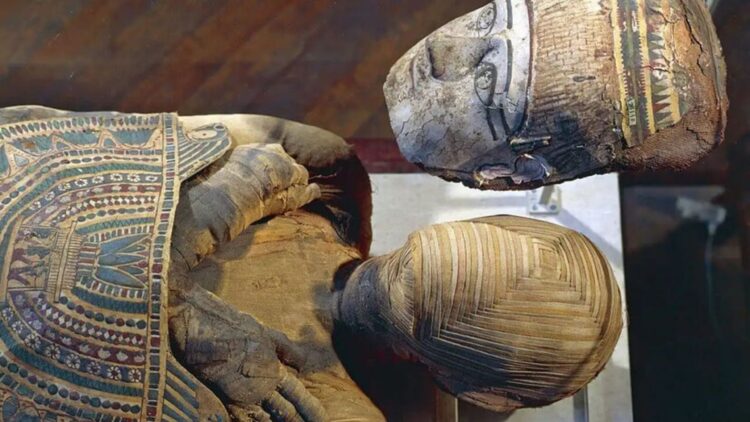
That’s the name of the mummy you see in the photo. It was discovered by Howard Carter in 1919 in the famous Valley of the Kings. Three years earlier, this Egyptologist had already discovered Tutankhamun’s tomb, but with this mummy, everything was different, none of his team members dared to unwrap it to see what was inside. And we’re talking about 1919! More than 100 years have passed, and to our surprise, Bashiri remains exactly as he was when they found him.
Why do they open mummies?
Mainly to study what’s inside them. Many have been perfectly preserved until they were discovered, allowing historians to understand how the Egyptian funerary rite worked (you know, the whole thing about removing the brain through the nose and then embalming), and of course, they later return them to their original state with all the respect these researchers show. But that’s not the case with Bashiri. And not because there’s any indication in his tomb, no, it’s something that draws even more attention.
A puzzle… in a mummy?
What makes Bashiri unique isn’t that he’s a mummy, we’ve seen many of those, nor his age, but the complexity of his wrappings. These linen wrappings seem very fragile and are “woven” in a way that resembles the Pyramids of Giza, as you can see in the photo at the top of this article. Egyptologists believe they wouldn’t be able to put it back together with the same precision if they removed it, and that it would be very difficult to remove without breaking it. Luckily, Egyptologists have made great advances that allow them to study what’s inside mummies without needing to unwrap them.
But… who was Bashiri?
The most incredible thing is that they still don’t know. Between the wrappings, the words “Bashiri” or “Neno” can be read two names that could mean the word “prophet” in Arabic. But his real identity is unknown.
We do know that he was male, 1.67 meters tall, and lived during the Ptolemaic period (early 3rd century BC). And although it’s not known exactly who he was or what family he belonged to, it is clear that this man had great importance due to the complexity of his wrappings (perhaps a religious leader or a community sage). But the wrapping is unique and had not been seen on any other mummy found.
Discovering… without desecrating.
That’s right. Thanks to major advances in science, CT scans and computed radiographs allow archaeologists to explore the inside of these mummies without needing to damage or desecrate them, as would have been done in the past. And regarding Bashiri, they discovered he was a very special person. Objects had been placed with great care, such as the Eye of Horus (for protection), sacred scarabs, and several papyri with hieroglyphs, all strategically placed, along with other elements like ankhs (for eternal life) and djeds (for strength), all made with gold, precious stones, or ceramics, including ushabtis, the elements that would become servants in the afterlife.
The mystery, and above all, the respect for the history of Ancient Egypt, is what has made Bashiri “the untouchable.” But the reality is, even though we’re dying to discover and reveal the past, respect must come before curiosity. And this mummy, which has been resting for more than 2,000 years, still speaks to us without saying a word (thank goodness!). And you, what do you think Bashiri was in life?