
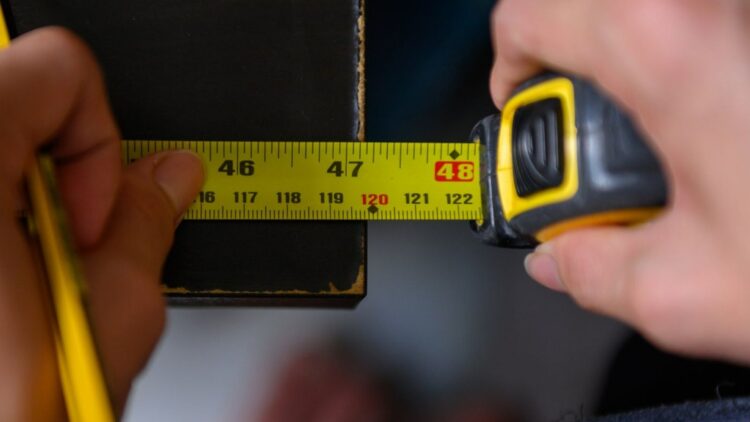
If you’ve ever used a tape measure for something more than hanging a picture, you’ve surely come across some strange marks in the shape of black diamonds. And most likely you just ignored them thinking they were a decoration, a factory error or simply something that was there “just because” (like us). Well, no. Those diamonds have a very specific function and can make your life much easier if you do DIY or renovations!
The secret of black diamonds
So next time you take out the tape, give it a try: look at those marks that appear every 19.2 inches. They’re not decoration, they’re not there randomly and, although many people don’t even notice, they make more sense than it seems! Want to know more?
And what exactly are they for?
Those diamonds indicate the points where you should place the joists when assembling a structure with five supports for each span of eight feet (2.44 meters). Basically, if instead of putting a joist every 16 inches (which is typical) you decide to space them out a bit more (every 19.2 inches, to be exact), those diamonds mark exactly where they go. That way the weight is distributed evenly using less material!
Quick translation? You can build more efficiently without compromising stability. Fewer joists, lower cost, same result… as long as the project allows it.
So why isn’t it always used?
Good question. And the answer is pretty logical: not all projects lend themselves to this type of distribution. In houses and constructions with more safety requirements, it’s still common to place joists every 16 inches. But in simpler things like sheds, porches or lightweight structures, using the diamond pattern is a totally valid and much more economical option.
The trick every DIY fan should know
If you’re one of those who assemble shelves, wooden structures or like to build your own furniture, this is for you. Because just by following those diamonds you can save wood and gain time. No need to measure each section to the millimeter: the tape is already telling you where to cut or nail.
It’s like having a silent guide in your hand whispering “the next one goes here”.
A detail that changes the way you work
The good thing about all this is that you don’t need to know trigonometry or have read three carpentry manuals. You just have to look closely at the tape. Because although it looks like a basic tool, even the tape measure we’ve used all our lives holds secrets most people never consider.
So next time you use it, remember the diamonds. They’re there for a reason. And now that you know what it is, you might start seeing your tape measure with new eyes. Now you’re well prepared for your next DIY adventure, will you tell us about it?!
Simple tricks that save you in any DIY job
- Learn your tape measure well: Yes, that thing that always rewinds by itself. It has more secrets than you think. The red numbers also have their purpose. Taking a look at them saves you more than one headache.
- The hook at the end is not loose by accident. That little “wiggle” is there so the tape measures correctly both on the outside and the inside. It’s not broken, it’s designed that way. Don’t tighten it with a screwdriver. Seriously.
- Don’t draw lines, make a ‘V’. When you mark something, don’t draw a straight line like you’re signing a check. Make a kind of “V” pointing to the exact spot. It’s easier to see and you’ll be more accurate.
- Stick a magnet on the tape. If you’re measuring metal things (like pipes, shelves, etc.), a mini-magnet on the tip of the tape can save you from needing three hands to measure. Works like a charm.
- Always keep the pencil sharp. The carpenter’s pencil is your best friend. But only if it doesn’t look like a chewed-up piece of gum. Sharpen it like you’re about to write a letter. The finer it is, the more precise.
- Stick masking tape where you’re going to cut. If you’re going to saw a nice board or something laminated, put some masking tape right where you’re going to cut. You’ll be surprised how well it prevents splinters.
- Don’t have a cutting guide? Make one up. Find a straight wooden strip (straighter than you on a Monday morning) and use it as a guide for your circular saw. It works great.
- Turn the drill into a screwdriver. You don’t need a thousand tools. Just change the drill bit for a screwdriver bit and that’s it: now you can assemble that piece of furniture without wrecking your wrist.
- Going to drill a tile? Use tape. Stick a bit of masking tape where you want to make the hole. It’ll keep the drill from slipping and, with luck, the tile won’t break into a thousand pieces.
- Organize screws with everyday items. Ice cube trays, pill boxes or even egg carton compartments work great to sort screws, plugs, washers… and not end up searching for them like you’re playing hide-and-seek.