
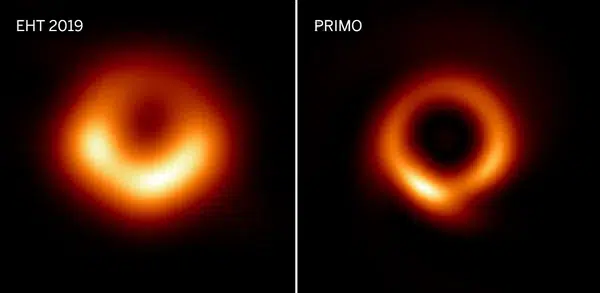
M87*, a black hole located at the centre of the elliptical galaxy Messier 87. A true monster that has captivated the attention of astronomers for being the first black hole ever directly photographed by humanity in 2019. It has a mass of 6.5 billion suns, and it also spins at 80% of the maximum speed allowed by physics.
Watch out, it’s not like the NHTSA is putting up traffic signs in space, but both its rotation speed and feeding rate were something incomprehensible until now.
The secret is in the ring: how the spin was measured
The EHT not only captured the famous image of M87*’s ring of light but also revealed an uneven brightness that, far from being random, is a clear example of the relativistic Doppler effect (an effect that changes the color of light when something moves very fast. When the object comes towards us, the light appears more blue; when it goes away, it appears more red. That’s how scientists know how fast it’s moving!)
42 million meters per second
Thanks to this contrast, the researchers calculated that the plasma closest to the black hole spins at 42 million meters per second, 14% of the speed of light!! This data allowed them to estimate the spin of the black hole: 0.8 on a scale where the maximum is 1. A figure that places it dangerously close to the theoretical maximum limit.
Feeding the monster: the matter that M87* swallows
This cosmic monster not only spins fast but also devours matter at a great speed! According to the study, matter falls at almost a quarter of the speed of light, and its accretion rate ranges from 0.00004 to 0.4 solar masses per year. Although it sounds enormous, it is well below the “Eddington limit” (the maximum amount of energy that an object like a black hole or star can emit before the pressure of its own light expels the material trying to fall on it), indicating that M87* is in a calm and steady feeding phase.
The link to the particle jet
The most interesting finding is that the energy of this process matches that of the relativistic jet that emanates from the black hole, a beam of particles stretching for thousands of light-years. So, the jet is not an isolated phenomenon, but a direct consequence of the matter falling into the black hole, in other words, this black hole is shaping the galactic environment as it pleases!
The spin, key to understanding galaxies and relativity
The spin of a black hole determines how it drags the space-time around it and how it affects the formation of relativistic jets. These jets can sweep away interstellar gas and dust, altering the rate of star formation and the evolution of entire galaxies.
Measuring the spin, of course, is not easy, but the data from M87* and the EHT offer a more direct and reliable method than previous techniques based on X-rays. The result? It falls at a speed of 70 million seconds, 23% of the speed of light!
M87* and the frontier of knowledge
With its extreme spin speed and its ability to endlessly devour matter, M87* has become a natural laboratory for general relativity and the most extreme fluid physics in the universe.
The study suggests that its spin of 0.8 could even be a lower limit, which would place it even closer to the theoretical maximum value of 0.998.
The black hole M87* is not just a visual icon thanks to the historic 2019 photo: now we know that its rotation pushes the boundaries of physics. Isn’t it incredible?