
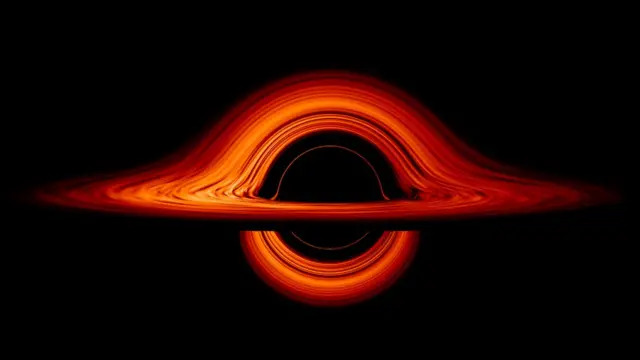
If you’ve ever wondered what a black hole looks like but never had the mental capacity to imagine it, you won’t have to anymore, because NASA (and the Event Horizon Telescope, let’s not take away any credit) have captured, for the first time in history, a direct image of a black hole!!!
Both NASA and the Event Horizon Telescope have revealed that the black hole M87 (the same one that became an icon of astronomy in 2019) spins at 80% of the cosmic limit and travels 240,000 kilometres… per second!!!
Beyond space-time
When we say the black hole spins at 80% of the cosmic limit, we mean it moves at a speed so enormous that it’s beyond human comprehension, like a galactic drain swallowing everything that gets close. Ruth Daly, an astrophysicist at Penn State University, puts it this way: it’s not just a huge mass; it’s a force that shapes everything around it.
The speed at which it orbits makes M87 the clearest example of how extreme gravity warps space-time, and that’s something that hadn’t been understood until this very moment!
A natural lab for general relativity
This black hole is surprising for many other reasons too. The plasma jets it emits are so powerful they can be observed with NASA’s telescopes, and they’re made of particles traveling almost at the speed of light, directly influencing galaxy formation.
But what does rotation have to do with it?
Alright, think of a black hole. Got it in your mind? This kind of phenomenon “steals” everything in its path, the faster it spins, the more it swallows, and that energy lets it keep collecting matter.
Twenty-four billion miles: how is that possible?
Wait, because that’s not the only incredible number. This black hole measures 38.9 billion kilometres in diameter, roughly 3,000 times the size of Earth and several times larger than Pluto.
M87 holds 6.5 billion solar masses. And it’s able to bend space-time in any direction.
What does this mean?
It means that, by swallowing dust clouds, it prevents new stars from forming too quickly and keeps M87 in a kind of thermal balance.
How can you see something that emits no light?
The key to detecting black holes like this is to observe what happens around them. In the case of M87, scientists have studied it thanks to the energy jets it shoots out and the glow produced by matter just before being devoured. You don’t see the black hole itself, but you do see its effects.
But how can it be seen if it doesn’t emit light? Very simple, you’ve probably heard that NASA’s telescopes use infrared and other cutting-edge technology that lets us see this giant even from our own planet!
What is the Event Horizon Telescope?
It’s a global network that merges radio telescopes from Hawaii to the South Pole. When synchronized, they reach the resolution of a telescope the size of Earth, enough to photograph the shadow of the black hole and register millisecond fluctuations in the ring of light. Amazing, right?
M87 is also relatively close (astronomically speaking) and very bright in radio waves.
And what about James Webb?
While the EHT captures radio frequencies, the James Webb Space Telescope records infrared from the dusty surroundings. The combination of multi-wavelength data allows scientists to reconstruct temperatures, speeds, and the composition of the plasma feeding M87.
This discovery opens up new questions. What happens when a black hole spins even faster? Is there a limit? Can similar ones form elsewhere in the universe? We can’t give you the answers… But we don’t know them. But one thing is clear: the universe still holds surprises that leave us speechless!