
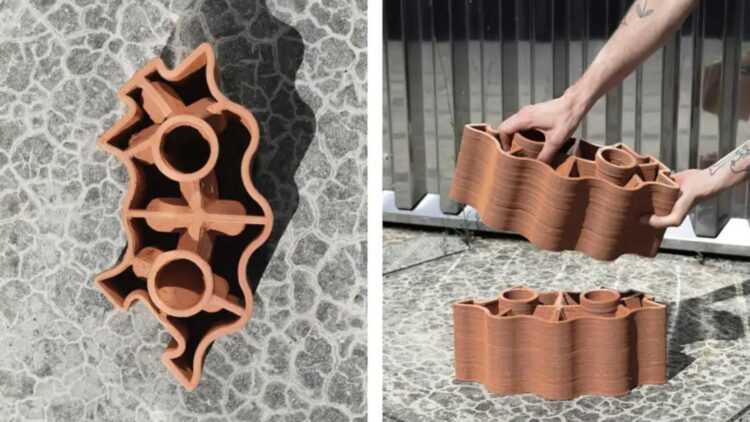
What if I told you there is a brick that cools cities? I’m telling you the truth, even though it doesn’t seem like it. Boiling hot temperatures is one of the big challenges of modern cities and the so-called urban heat islands make temperatures in areas with no shade more difficult to bear with the passage of time. What’s the solution for this situation? Well, two young students from the Zurich University of the Arts, Andrin Stocker and Luc Schweizer, have created Bloc which is a modular terracotta brick capable of reducing up to 9 degrees the temperature in urban areas.
This innovative brick has made it to the final of the prestigious James Dyson Award thanks to their simple, efficient and sustainable idea. So, let’s find out more about it.
Inspired by traditional methods
The Bloc brick is not an idea that comes out of nowhere, the creators were inspired by ancient passive cooling techniques:
- Terracotta jars, which keep water cool through natural evaporation.
- Termite mounds, which regulate temperature and airflow in nature.
- Badgir, traditional wind catchers from the Middle East that ventilate and cool buildings.
What’s more, found inspiration in cactus geometry, which reduces direct exposure to the Sun. This way, they were able to achieve a design that makes the most of the traditional knowledge and they adapted it to a modular format and combined it with new technologies.
How the brick works
It’s made of 3D-printed porous terracotta and its system is simple but very effective. So, let’s see how it works:
- The porous clay absorbs water.
- As hot air flows through, the water evaporates and cools the surrounding space.
- Small fans and water pumps powered by solar energy improve airflow and accelerate cooling.
Imagine a more than 30 degrees day, each module will consume about 50 liters of water. This water can come from the city’s infrastructure or from its own rainwater collection system, which can gather an average of 24 liters per day.
A small solar panel generates around 200 Wh per day, enough to power both the fan and the pump. This makes the brick fully autonomous, requiring no external electricity.
Advantages of the Bloc brick
Not only this brick is efficient, but also sustainable, adaptable and scalable:
- Can reduce temperatures by up to 9 °C in hot climates.
- Requires no refrigerant gases or traditional electricity.
- Is modular, meaning it can grow both in height and width without losing efficiency.
- Each brick stores its own water, overcoming the limitations of other passive systems.
- Its active airflow makes it effective even in humid climates such as Central Europe.
In addition, the design was improved with virtual reality glasses, which allow students to work in 1:1 scale and simulate its integration in public spaces. What was the result? An efficient, aesthetic, and socially inclusive system.
Using it in cities
THe creators see this brick as an ideal solution for places where people need to avoid the heat like:
- Public transport stops.
- Plazas and school courtyards.
- Unshaded urban areas.
They are also thinking about trying it on building facades or even to cool interior spaces like industrial warehouses.
What’s next for the brick?
Even though some prototypes have been developed, the project still needs real-world field testing. These testings are key to check its performance in the long term and in different climate conditions.
The students also want to collect data and opinions to improve the design, increase the efficiency and simplify the installation. In the future, they would like to expand its application in more urban and industrial contexts. What do you think about this innovative way to contribute to the extremely hot weather in modern cities?