
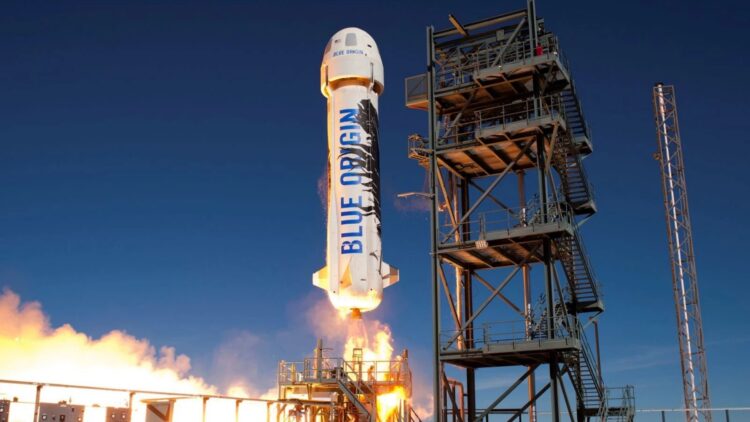
SpaceX is losing spaces (pun intended) and Blue Origin is stealing the spotlight. With the imminent launch of its Blue Moon Mark I lunar module, Jeff Bezos’s company is seeking to establish itself as the true leader in lunar exploration. And NASA? What role does it play in all this? We’re going to tell you everything.
Return to the Moon
For years, SpaceX has captured attention with its powerful Starship, but, as they say, those who eat in silence eat twice. That’s why Blue Origin has been quietly working on a more modular and efficient architecture. Its Blue Moon Mark I, which will launch soon on an uncrewed mission, will be the first piece of a strategy aimed at revolutionizing the human presence on the Moon.
The Blue Moon Mark I
The Mark I is not just a technological testing ground, it will also carry equipment needed by NASA, so it’s sort of a tandem effort. With launches planned every six to eight months, Blue Origin is creating a chain of lunar modules that will improve with each version and, above all, consolidate its presence in space.
Blue Moon Mark II: the true crown jewel
But they’re not stopping there. The even more ambitious Blue Moon Mark II is designed to carry up to four astronauts or 30 tons of cargo. This module will be essential for missions to the Gateway station and future collaboration with the Orion spacecraft.
Its ability to refuel in lunar orbit, thanks to the Cislunar Transporter (a tanker) that will transport up to 100 tons of propellants, and sorry for SpaceX’s Starship, but it’s much simpler and more straightforward than Musk’s ship.
More technology, longer missions
One of the biggest challenges of these missions is maintaining the cryogenic propellants, so Blue Origin is developing zero boil-off storage, with a crucial test coming up next June.
Can SpaceX react?
The competition is fierce, and although SpaceX has been the king of commercial space exploration so far, Bezos’s company is making steady progress. Musk’s Starship is powerful, but Blue Origin’s strategy seems much more versatile: lower technical complexity and a plan for regular launches that will make it easier to dominate the lunar orbit. Musk, time to wake up…
And NASA?
The White House has decided to bet on more agile public-private partnerships. With the possible cancellation of the SLS and Orion, NASA’s focus is now on companies like Blue Origin and SpaceX to lead lunar exploration through its Artemis program.
That’s why this partnership between these companies and NASA will be crucial for the near future. Who knows, maybe we’ll even see the two magnates setting foot on the Moon!
Mexico? Its role in the lunar race
Surprisingly, NASA has asked Mexico for help to participate in this major project! This shows that lunar exploration isn’t just a competition between big companies, but an effort by everyone.
Differences between them
| Aspect | NASA | SpaceX | Blue Origin |
| Main Role | Government space agency | Private space company | Private space company |
| Focus | Develop Orion & SLS, lunar orbit | Starship to the Moon and Mars | Blue Moon lunar landers |
| Lunar vehicle | Orion + Gateway (station) | Starship | Blue Moon Mark I & II |
| Launch frequency | Low (1-2 missions/year) | High (Starship test flights) | Frequent (~6 months between launches) |
| Reusability | Limited (Orion, SLS not reusable) | Fully reusable (Starship) | Reusable landers (goal for Mark II) |
| Fuel strategy | Traditional refueling on Earth | In-space refueling via tankers | In-space refueling in lunar orbit |
| Global partnerships | Strong alliances (ESA, JAXA, etc.) | Less reliant on global partners | Emerging global alliances (including Mexico) |
| Core mission | Scientific exploration & ISS | Colonization & commercial flights | Commercial lunar transport & crew delivery |
The race to the Moon is no longer just a dream of NASA; now, three different teams are on the verge of marking a turning point. And who knows, maybe that “small step for man” will end up being “a giant leap for mankind”! See you soaring through the stratosphere!