
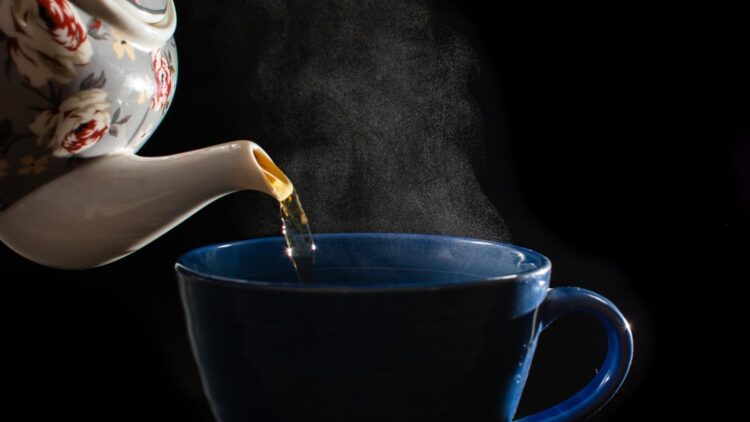
A group of British researchers have proved that one of the most beloved traditions in the U.K. (having a cup of tea) could one day be done on the Moon. What? It sounds crazy, right? But scientists from Kent University were able to grow tea plants in a soil designed to imitate the conditions of the lunar surface, which brings new possibilities for life beyond Earth. So, let’s find out how this would be possible.
A British experiment with tea and space.
The project was led by professor Nigel Mason, from Kent’s School of Physics and Astronomy, and Dr. Sara Lopez-Gomollon, from the School of Biosciences. Along with research students Anna-Maria Wirth and Florence Grant, wanted to check if tea could grow in such extreme conditions as the ones in space.
How did they do that? Well, they planted young tea saplings in special soils created to replicate the ones found on the Moon and Mars. Also, they planted a control group of saplings in ordinary Earth soil to compare the results.
Tea growing in lunar conditions
For weeks, the saplings were exposed to similar conditions to the ones expected in space: temperature, humidity and lightning, all carefully controlled. The results were shocking:
- The tea plants in the lunar soil simulation took root and grew successfully.
- The control plants on Earth soil also grew as expected.
- However, the tea plants in the Martian soil simulation failed to grow at all.
Researchers described the plants in lunar conditions as having ‘’flourished’’, which proves it’s possible to grow tea in an environment similar to the Moon.
Why this British success matters
The study is part of investigations about space agriculture, the idea of growing food directly on the Moon or Mars to supply astronauts who someday live and work there for long periods of time.
According to Dr. Lopez-Gomollon: “The results of this project are very encouraging, as they demonstrate that tea, a crop, can be grown in lunar soils.” She added that the next step is to better understand the physiology of the plant under these conditions to improve its growth and apply this knowledge to other crops.
Professor Mason highlighted its scientific value and the cultural importance of this finding: “We are at the very earliest stages of research into space agriculture, but it is reassuring that we may be able to provide access to the great British tradition of a tea break.”
Lessons beyond space
Even though the experiment was designed based on the Moon and Mars, the results are also relevant to our planet. Studying how plants react to hostile soils help understand how crops could survive in difficult environments on Earth.
This information is specially useful in a time known for climate change and over-farming, which are factors that affect the quality of the soils. So, learning how to grow plants in tough conditions could offer solutions for the global farming future.
A British collab
Other partners were also involved in the study: Dartmoor Tea, a British tea plantation that provided expertise on the crop; Lightcurve Films, specialists in space documentaries; and Europlanet, a European network of planetary scientists.
This team effort shows how science, culture and international partnerships can join in innovative projects. A simple question as ‘’can tea grow on the Moon?’’ has given answers that could influence future space missions and agriculture here on Earth.
Have you ever thought this would be possible someday? I mean, this seems like something taken from a science fiction movie script, but it is happening in real life! We are constantly receiving news about space, isn’t it crazy?