
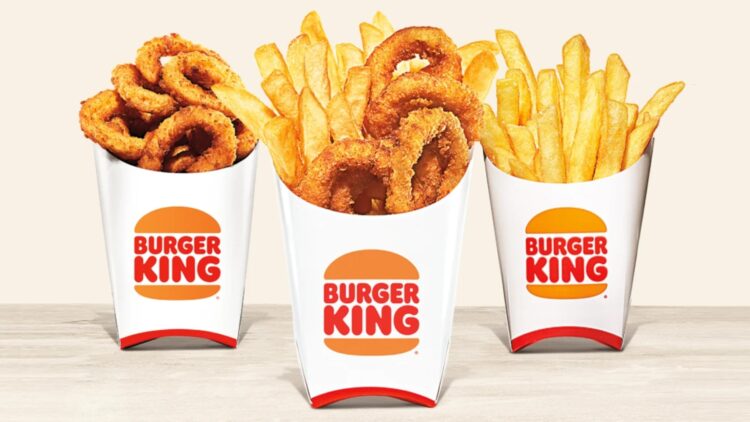
Are you a fan of Burger King’s onion rings? If the answer is yes, I’m afraid you will be disappointed when you find something about them… For a long time, many Burger King’s customers believed that its onion rings were made with fresh onion. However, it was confirmed what some people suspected: the onion rings were made with a processed mix that barely contains onion derivatives.
This finding has divided many customers: for some, the formula is practical and even attractive; whereas for others, it’s disappointing to know that the product isn’t like the traditional onion ring. So, let’s talk a bit more about this famous Burger King product.
Inside the onion rings
According to the list of ingredients published by Burger King, the onion rings are made with nearly 30 ingredients in total. From all of them, only 4 of them are directly related to onion: dehydrated onion pieces, dehydrated chopped onion, onion powder, and a flavoring simply identified as “onion flavor.”
This means that the onion rings’ flavor comes from more processed ingredients than from fresh onion.
Why Burger King doesn’t use real onion
The decision of not using fresh onion is a matter of being practical. In fast food chains like Burger King, the priority is consistency and standardization across the millions of portions served daily worldwide.
While French fries can be cut and cooked in mass quantities without major variations, onions are much more complicated because: they come in irregular sizes, they have a shorter shelf life, and they spoil more quickly than other ingredients.
So, by converting onion in powder or paste, Burger King obtains an ingredient that it’s easier to store, transport, and mold into circular shapes that always taste the same. This way the company makes sure onion rings have the same texture and flavor at any restaurant.
Customers’ opinions
The fact that Burger King’s onion rings are not really made with fresh onion has made people be open about it and it has generated a huge debate.
On the one hand, some clients celebrate this method because they say they enjoy them since the onion rings don’t have the strong taste that natural onion does. For example, a user on Reddit commented: “I hate onion. The only reason I like Burger King onion rings is because they aren’t really onion.”
On the other hand, other clients are disappointed. For them, the product doesn’t follow what it’s said on its name. In this case, a consumer wrote: “I hadn’t ordered onion rings at BK in a while and what I got was ridiculous… little onion-flavored donuts. How can they call them onion rings?”
Fast food logic
Beyond critics, the formula makes sense with the fast food logic. In Burger King the goal is to offer products that are affordable, easy to mass produce, and with the same flavor at every of its restaurants. These onion rings aren’t thought to be an artisanal product of a traditional restaurant, but to be a quick, crunchy and accessible side dish for millions of clients.
‘’Have-sies’’
Even though onion rings themselves generate debates, Burger King found success with a product that combines them with another classic: French fries. The option called “have-sies” includes in a single order half fries and half onion rings.
This product has become a customer favorite because it eliminates the need to choose between fries or onion rings. Many see it as the perfect way to enjoy the best of both worlds in one serving.
So, what do you think? Is it okay with you or do you belong to the customers who think it’s disappointing?