
The world is changing a lot with AI and China is putting its faith in it too. Artificial intelligence is shaping up to be the foundation of the Fourth Industrial Revolution. While many countries are still debating how to integrate AI into their school systems, for China AI is the new literacy. This country believes mastering AI is essential to leading the future. So, let’s find out more about this situation.
AI from early childhood
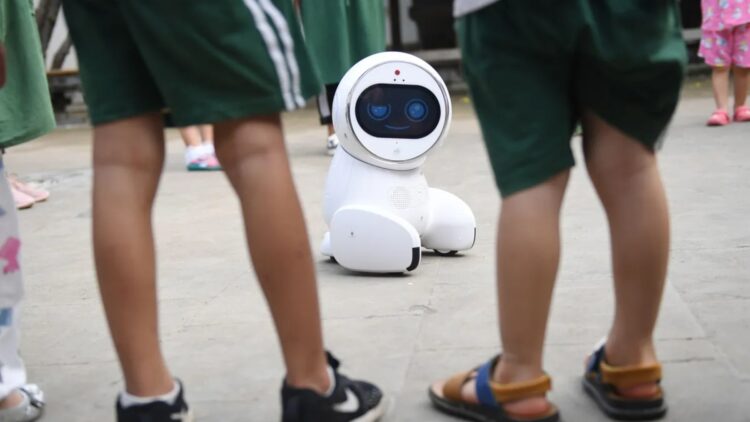
In China, 4-year-old children are already interacting with educational robots and intelligent applications in the classroom. This is not done to be seen as a futuristic country, they are preparing the next generation to know how to use digital devices and develop deep computational thinking by understanding what an algorithm is and how a machine “learns.”
In large cities such as Shenzhen and Beijing, children are growing up with AI just as naturally as they learn to read or write. China’s Minister of Education, Huai Jinpeng, has set an ambitious goal: by 2030, China aims to become the world leader in technology.
Robots and apps in the classroom
I know this might seem like something taken out of a science-fiction movie, but in kindergartens and schools, technology like Doubao, which can recognize images and respond to voice commands, are already part of daily lessons. What’s more, children also work with AI apps and language models to solve problems, imitate how machines think, and practice basic algorithmic skills. Isn’t it incredible?
China wants to make AI learning as intuitive and natural as picking up a new language. Just as a child who starts English early can speak it fluently, a child in China who grows up with AI will be able to use and understand it with no effort when they are adults.
China vs. the world
China isn’t the only country to include AI in its educational system. Let’s see some of the countries joining this idea:
- South Korea and Singapore have also been doing it for years by training teachers and students alike.
- Finland has gone even further, offering free AI literacy courses to all its citizens, convinced that the future depends directly on this skill.
However, this is not the same in the U.S. where ongoing debates about ethics and teaching methods are slowing progress. This delay could soon put the U.S. at a strategic disadvantage compared to China and its neighbors.
Why start with children?
Neuroeducation experts explain that the earlier you learn a language, the more naturally it becomes part of you. So, the same applies to AI: Children who begin using artificial intelligence at a young age don’t just learn how to use it—they also develop thinking skills that prepare them to adapt and innovate in a rapidly changing world.
Learning to “think like AI” gives kids the mental tools to handle complex problems. That’s why China wants to prepare its kids, to make them ready to drive technological progress and secure the country’s leadership for the future.
The risk of falling behind
A country whose citizens don’t grow up learning AI tend to lose ground in the most important industries of the 21st century. It could also create deep social and digital divides that are hard to close later.
The consequences go far beyond economics since artificial intelligence will also be critical in cybersecurity, defense, scientific research, and national stability. Countries that lag behind may find themselves dependent on technologically stronger nations.
So, in a world where artificial intelligence will soon be as essential as reading or writing, China’s decision to make AI the new literacy could very well determine who dominates the global stage in the decades ahead. Do you think the U.S. should be doing the same as China?