
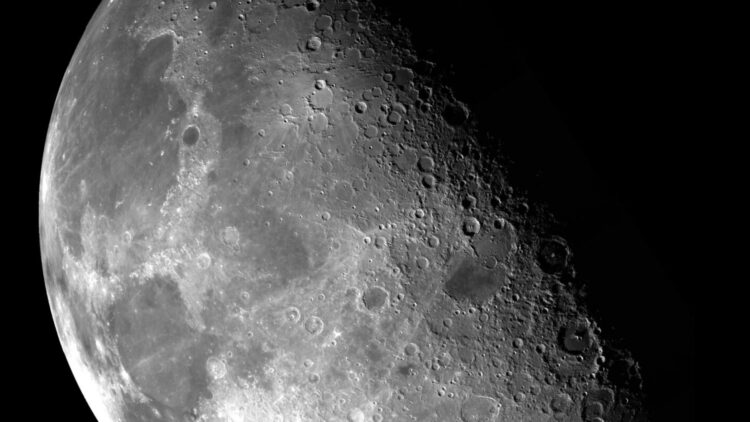
The Moon has just revealed one of its best-kept secrets, or rather, it has been revealed by a group of Chinese researchers who confirmed the existence of a magma ocean on its far side. This not only revolutionizes our understanding of the Moon, but also reinforces the theory that our satellite has two hemispheres… and that they shared a common origin.
This discovery was made possible thanks to the Chang’e-6 mission, which managed to bring direct samples from that unexplored region back to Earth. And the most impressive part? The confirmation that this “ocean” wasn’t made of water, but of molten rock!
So, we might start saying that in its early days, the surface was completely covered in liquid magma. Want to know what else is being said about the Moon?
The far side of the Moon
In 2024, China launched Chang’e-6, a probe designed to land on the least explored area of the Moon: its far side. As you already know, this area has been the subject of multiple theories and studies. The goal was clear: collect soil samples and bring them back to Earth for analysis. The operation was a success, and the team managed to collect two grams of lunar material.
Why this part of the Moon?
As we mentioned, the far side of the Moon has always been a mystery. While the near side has been widely studied, the other half remains full of unknowns even today.
China wanted to test a hypothesis: that in its earliest stages, the entire Moon was covered by a magma ocean. But where could that magma ocean be? Where no one was looking.
An ocean… of lava?
Once in the lab, the analysis of the collected samples began. These revealed fragments of basaltic rock (the same type of volcanic rock found in other parts of the Moon), but the most interesting part wasn’t that, they also found elements like uranium and lead. What does this mean? The magma ocean hypothesis!
The magma theory?
This theory states that the impact that formed the Moon generated heat so intense that it melted the entire surface, affecting both the near and far sides, creating an ocean of molten rock that would take years to solidify. WOW! Not even the Illuminati saw this coming.
Why should we care?
A lot!! Until now, it was believed that the far side might have formed differently, since it didn’t show the large volcanic plains seen on the near side. However, the data from the Chang’e-6 mission proves the opposite: there was also intense geological activity over there.
What is the SPA basin?
One of the largest craters in the solar system. In fact, it’s believed this basin may have even altered the lunar mantle in that region!
And now, what?
The Moon has always kept secrets, but we’re getting closer and closer to uncovering them bit by bit. Far from being a “boring” satellite, it continues to surprise us, and now more than ever with this incredible discovery!
Did you know that…? Key factors!
The Moon is much more than Earth’s companion, and, we are giving you a few facts that show just how unique and mysterious it really is:
- The Moon is slowly drifting away from Earth, it doesn’t mean that doesn’t love us anymore, but is drifting away at a rate of about 3.8 centimetres per year! It means that in millions of years, solar eclipses will no longer occur.
- It has moonquakes. Just like Earth has earthquakes, the Moon experiences seismic activity too, called moonquakes, isn’t it cute?
- There’s water on the Moon. While it’s not flowing like rivers, frozen water has been detected in permanently shadowed craters near the poles.
- It always shows us the same face. The Moon is tidally locked with Earth, meaning we only see one hemisphere from the ground. The “far side” remained unseen until the space age… Interesting, huh?