
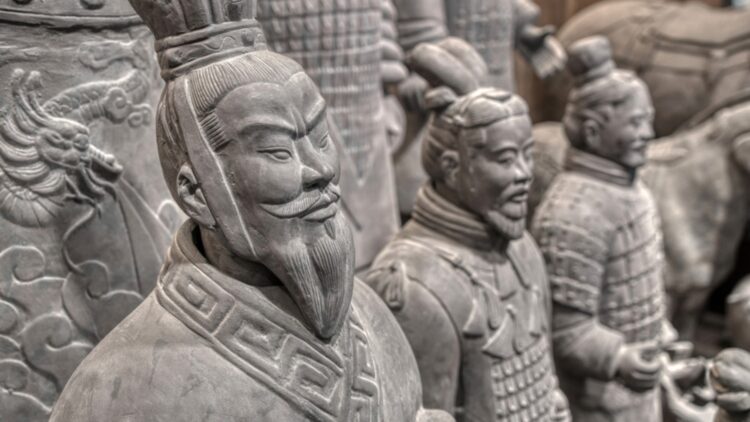
New archaeological discovery! This time in China, where researchers found a 16-ton tomb inside the Mausoleum of the First Qin Emperor in Xi’an. This tomb, which remained untouched for more than 2,000 years, contains treasures and objects that could help unlock the ancient legend of the Qin dynasty. The tomb is part of the vast funerary complex where the world-famous Terracotta Warriors were discovered, adding even more importance to the find. So, let’s see more in detail about this discovery in China.
The treasure in the heart of China
Archaeologists found that the tomb contained a huge variety of valuable pieces like:
- Jade artifacts
- Gold and silver camel figurines
- Weapons and armor
- Around 6,000 bronze coins
Archaeologist Jiang Wenxiao, expressed his surprise for the impeccable condition of the tomb: “Most ancient tombs have been robbed, so we didn’t have much hope for the coffin chamber. But it turned out it hadn’t been robbed. We were amazed.”
The tomb and the Prince Gao legend
The Mausoleum belonged to Qin Shi Huang, the First Emperor of China, who was famous for joining the country and building the Great Wall and the Terracotta Army.
Historical records describe the tragic fate of his son, Prince Gao, who became entangled in a fierce struggle for power after the emperor’s death. According to legend, Prince Gao requested to be buried within his father’s mausoleum.
The grandeur of this newly discovered tomb, along with its location close to Qin Shi Huang’s burial site, has led some to believe that it may be the final resting place of Prince Gao. If true, this would provide a direct link to one of the most mysterious stories of the Qin dynasty.
Precision and grandeur in construction
The significance of the tomb lies not only in its treasures but also in its structure. Wenxiao explained: “The tomb was so precisely built. So deep, so large in scale.”
Such careful construction suggests that the person buried here held a position of great importance within the Qin dynasty’s hierarchy.
Prince Gao or noble warrior?
Even though the hypothesis of the tomb being Prince Gao’s is compelling, Jiang Wenxiao is very cautious about it. He points out that after the first emperor’s death, all of his children had a very tragic destiny and this is why it’s possible the tomb doesn’t belong to Prince Gao, but a noble warrior.
What’s for sure is that the tomb stands out as one of the most impressive discoveries inside the mausoleum, offering rare insight into the political and military elite of ancient China.
Key archaeological finding fo China’s history
Since the tomb’s conditions are great, although it is from more than 2 millenia, it offers a unique opportunity to better understand life and costumes from the Qin dynasty. This discovery also reinforces Xi’an’s reputation as one of the most important archaeological centers in China, alongside the Terracotta Warriors, in helping the world piece together the history of the country’s first imperial dynasty.
To sum up
The discovery of this tomb in Xi’an is not just another archaeological find—it is a powerful window into the history of China and the enduring mysteries of the Qin dynasty.
Filled with jade treasures, gold and silver figurines, thousands of bronze coins, and weapons, the tomb reflects the wealth and craftsmanship of its era. Whether it belongs to Prince Gao or a noble military leader, its discovery adds a vital chapter to the story of Qin Shi Huang’s legacy.
As research continues, this intact tomb may finally help solve a 2,000-year-old legend while reminding the world of the remarkable cultural heritage preserved in China.