
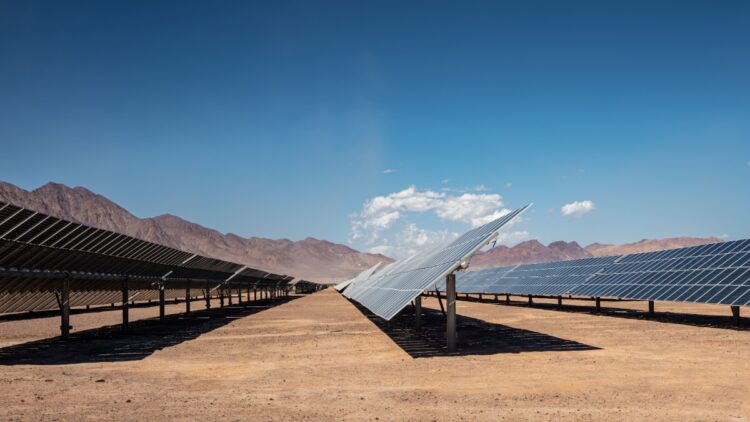
We usually associate the term “desert” with a vast, empty space, with sand, where there is no water and it is very hot, but now China has just shown that deserts can be transformed into something completely new and different: a clean and surprising source of energy that serves as a root from which the rest of nature can continue to recover.
In the Tarlatan Desert, China installed one of the largest solar parks in the world, Qinghai Gonghe. At first, the idea was clear: generate renewable energy on a large scale. However, what no one expected was that the solar panels would completely change the ecosystem of the area.
How can solar panels improve a desert?
Going back to using our imagination, a desert is a place where the sun beats down hard and water disappears quickly, right? But now, a Scientific Reports study from Xi’an University of Technology has caught the attention of the entire community because, by covering large areas with solar panels, shade was created on the ground, which made the water stop evaporating so quickly.
What is the study about?
Not only was it about creating more solar energy through these solar panels, but in the shade of these panels the humidity of the soil increased, and plants began to sprout and microorganisms that could not previously survive in such hostile climates began to grow, it is as if they had brought back to life what was previously dead.
Temperatures changed too
Yes, another surprise was that the solar panels affected the temperature of the place, and they observed that during the day the land stayed cooler, and at night, the temperature did not drop as much, almost like the climate in coastal places.
If you wonder why this is important, think that the huge temperature changes that occur in deserts are one of the reasons why the soil in them erodes more quickly. By stabilizing the temperature, the soil is prevented from breaking up and being lost to the wind.
How was this research carried out?
The scientists wanted to understand how a solar power plant could affect the environment. To do so, they used a method called DPSIR (“Driving Pressure-State-Impact-Response”) that helps measure the ecological impact of a facility. It is a fairly reliable system because it is recommended by the European Environment Agency.
To do their analysis, they studied 57 different factors that could influence the environment. They then used a special method called “entropy” to decide which of those factors were most important.
What was the result of the study?
The scientists measured how the environment was in different parts of the solar park and gave it a rating.
- Within the solar park, the score was 0.4393, meaning that the situation was “general” – neither very good nor very bad.
- In the surrounding areas, the scores were lower (0.2858 and 0.2802), indicating that those areas were in worse shape.
But here’s the interesting part: the scientists found that the shade from the solar panels actually helped improve the environment in some ways. It improved the soil, reduced air pressure and increased humidity, which created a more stable microclimate.
Is this the solution to climate change?
We can’t say that filling deserts with solar panels is the magic solution to the problem of climate change, but it is an important step. This experiment has shown that it is possible to generate clean energy and, at the same time, help to recover degraded lands without causing a great environmental impact in the placement of these elements.
If things are done well, this could be a key strategy for other countries to take advantage of their arid areas and reduce their dependence on fossil fuels. The future is already coming and we have to hurry!